|
|
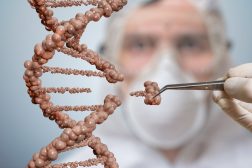
Dictionary » S » Split gene Split genesplit gene --> introns Non-coding, intervening sequences of dNA that are transcribed, but are removed from within the primary gene transcript and rapidly degraded during maturation of messenger RNA. most genes in the nuclei of eukaryotes contain introns, as do mitochondrial and chloroplast genes. ![]()
Please contribute to this project, if you have more information about this term feel free to edit this page ![]()
Results from our forumGenetics with Mitosis and Meiosis... I got anything wrong. Anaphase (in any type of division) is after the genetic material has separated and is being pulled toward the ends of the ... II is basically like mitosis in that sister chromatids are being split apart, but there are half as many chromosomes (one from each homologous ...
See entire post
Re:... there is some small alternative-intron in your exon, which can be thus split why are you using primers only for one exon at a time? Is your aim ... 4 sets of primers. I was going to amplify 4 overlapping regions of the gene, run them on a gel, cut out the bands of expected size, purify them, ...
See entire post
Real Time reverse transcription PCR Questions... in mind is to transfect my cells with my desired proteins and when I split my cell lysate I will keep one for protein and one to isolate RNA. ... I know this is a dumb question but I’m having trouble locating my exact gene sequence! My project is on IL6. I used NCBI to search and found IL6 ...
See entire post
Molecular gene (genome) concept scientifically untenableFor nearly six decades now, biologists have been promoting molecular gene (DNA) as the blueprint of life. The world now believes that it is a chemical ... a single messenger RNA. Rather, most eukaryotic genes consist of split DNA sequences, often producing more than one mRNA by means of complex ...
See entire post
Re: Human evaluation... (as with most of the human population), and are thus part of the same gene pool. I think this makes them unlikely to diverge/speciate unless the ... not speciate over the 50-60,000 years since the populations originally split apart - and in relation to our biological mechanisms, the differences ...
See entire post
This page was last modified 21:16, 3 October 2005. This page has been accessed 8,157 times. |
© Biology-Online.org. All Rights Reserved.
Register | Login
| About Us | Contact Us | Link to Us | Disclaimer & Privacy