Replication
n., plural: replications
[ɹɛplɪˈkeɪʃən]
Definition: process of duplication, e.g., DNA replication
Table of Contents
Replication, in the general sense, is to create a copy or a duplicate. Thus, in biology, replication is commonly associated with DNA (DNA replication) where the DNA is copied prior to cell division. Apart from that, replication also refers to the duplication of a laboratory or experimental procedure, which is essential for research statistics. But let us first understand the concept of biological replication, particularly one involving DNA.
Replication Definition
How to define replication in biology? In biology, all life will cease to exist without replication. Biological replication is the essential force in biology that sustains all life on earth whether it is unicellular or multicellular. At any given point, millions of replications are taking place inside all organisms. Almost every cell contains its own DNA. DNA is the parent molecule that is responsible for coding all the necessary information for a particular species. As the cells divide, it is equally necessary for this parent molecule to divide. For equal division of the cellular DNA between two daughter cells, it’s also important for the DNA to create a copy of itself first. The very purpose of replication is to ensure that every daughter cell is functionally independent. So, when asked to define replication in this regard, one can tell that it is a molecular process through which the cellular DNA creates a copy of itself. The word “replica” itself means an exact reproduction or replication in Science. Now that we have learned the definition of replication in biology, let’s move ahead and get to know the structure of DNA.
Replication is a biological process of duplicating or producing an exact copy, such as a polynucleotide strand (DNA). DNA replication is one of the most vital biological processes in all living things. It is a molecular process taking place in dividing cells by which the DNA creates a copy of itself. Another use of the word “replication” in biology is about carrying out a similar procedure. The repetition of a laboratory procedure is an example in this regard. Having replicates is essential in scientific experiments and statistics so as to draw a more precise conclusion from the experimental outcome. Etymology: from Latin replicātiō (a folding back). Synonym: duplication (general); repetition (general).
Structure of DNA

To understand the process of replication we first need to understand the structure of DNA. The structure of DNA was originally unveiled by two scientists James Watson and Francis Crick for which they were awarded the Nobel Prize in Physiology or Medicine in 1962.
The list below highlights the salient features of the Watson and Crick model of DNA:
- DNA is made up of two polydeoxyribonucleotide chains that run parallel to each other and arrange themselves in a right-handed helix.
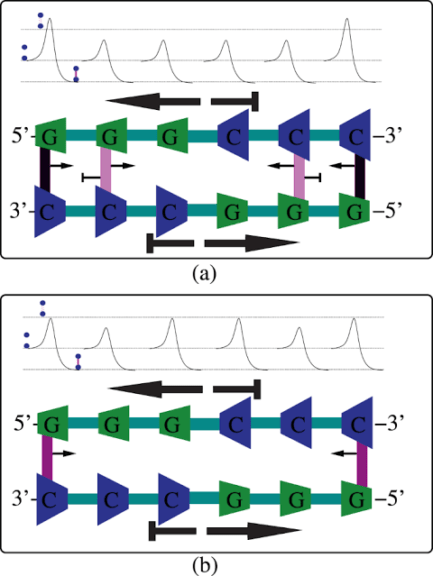
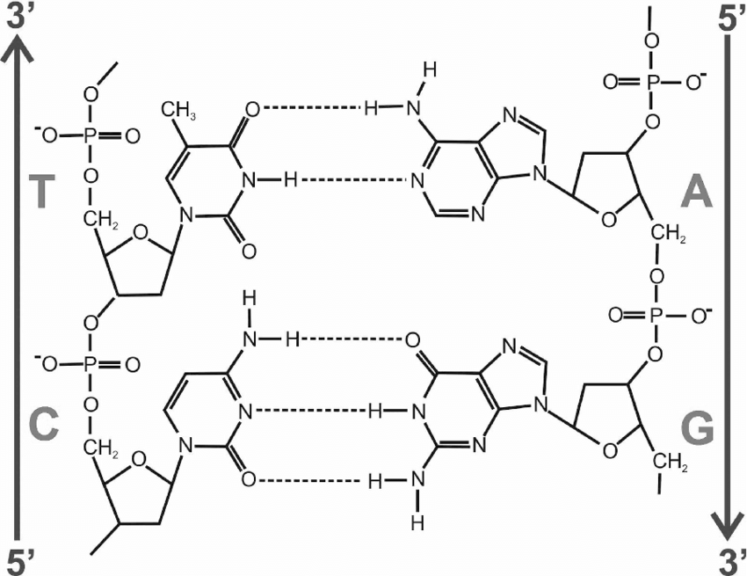
- The two strands run antiparallel to each other. Each DNA strand has a 5’ end & a 3’ end. The 5’ end of one strand comes next to the 3’ end of the other strand. (See Figure 2)
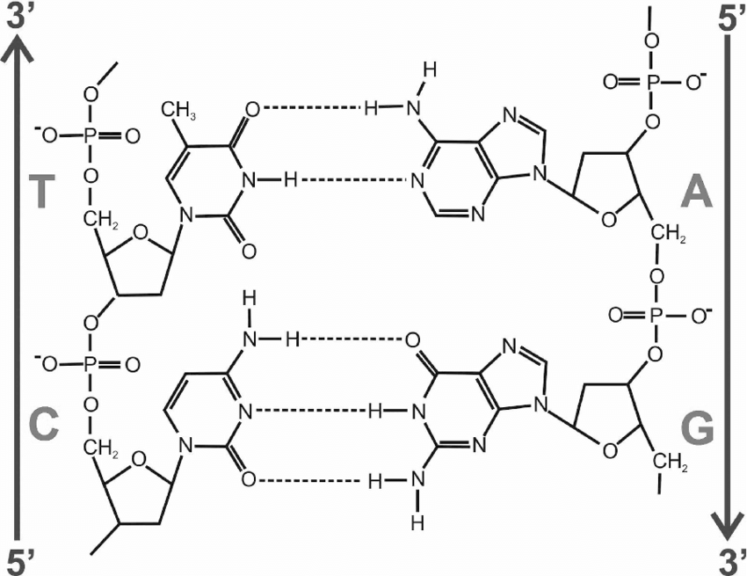
- The two strands of the DNA are held together with the help of hydrogen bonds that are formed between the nucleobases.
- The DNA follows a rule of base pairing: –
- Adenine always pairs with Thymine forming 2 hydrogen bonds.
- Guanine always pairs with Cytosine forming 3 hydrogen bonds. (See Figure 3)

Figure 2: Antiparallel strands of DNA. Image Credit: Hemachander Subramanian and Robert A. Gatenby (open access article) 
Figure 3: Note the two hydrogen bonds between adenine (purine) and thymine (pyrimidine) and three hydrogen bonds between guanine (purine) and cytosine (pyrimidine). Image Credit: Mary Philips Jones et al. (article, CC-licensed figure - No. of purines (double-ringed structures) present in DNA is exactly equal to the no. of pyrimidines (single ringed structures) present in the DNA. This is famously known as the Chargaff’s rule.
- The bases stack above one another with the help of Vander Waal forces that act vertically between the bases.
- The major and minor grooves of the DNA are the primary sites for protein interaction.

Figure 4: minor and major grooves of DNA. Image Credit: Blessy Mathew et al. (article) - The diameter of a helix is 2 nm thick. Each helical turn contains 10 base pairs. The distance between two base pairs is 3.4 Å or 0.34 nm. The height of each helical turn is thus 34 Å.
Figure 5: different measurements of DNA, Image Credit: David J Bakewell (article)

Steps of DNA Replication
Five steps of DNA replication:
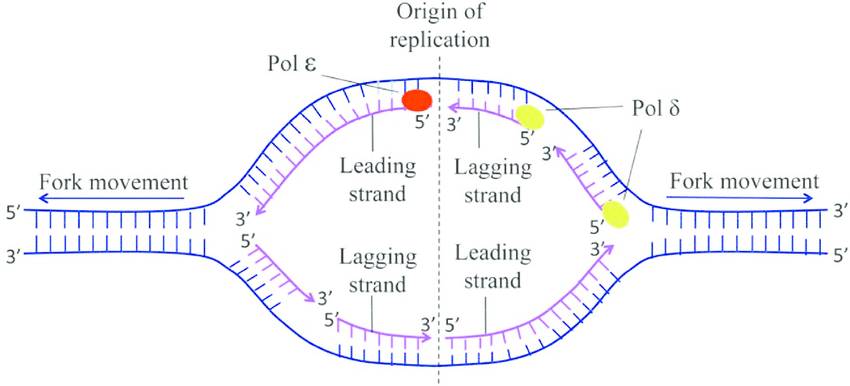
Step 1: Identification of the origin of replication (ori)
It is the point where the DNA replication begins. Right next to ori there is an AT-rich portion of DNA to which ori binding proteins bind. The ori binding proteins unwind the DNA at ori. The unwound DNA is stabilized by the single-strand binding proteins (SSB) that prevent the reannealing of the DNA.
Step 2: The unwinding of the DNA
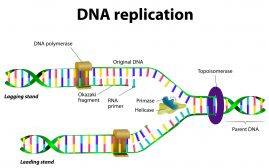
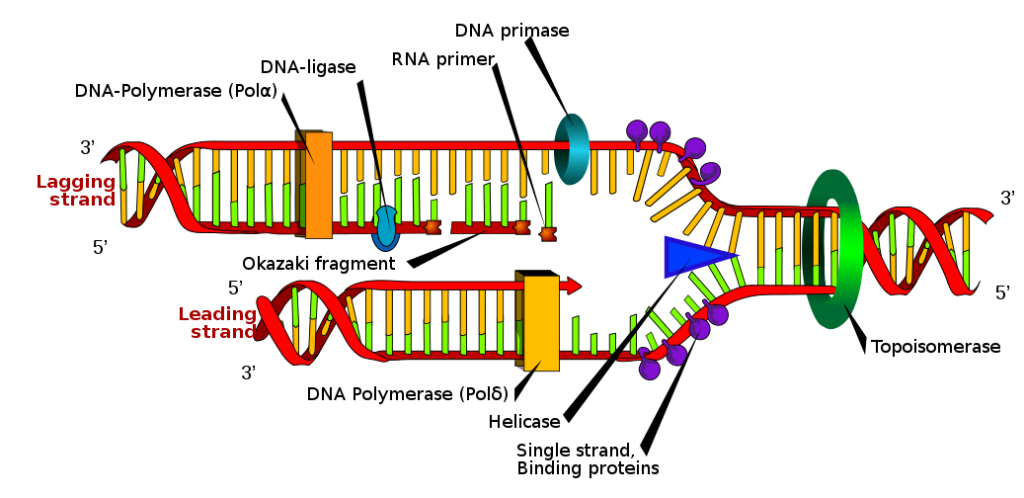
The further unwinding of the DNA is carried out by the enzyme helicase. As the helicase enzyme is acting, supercoiling occurs ahead of the replication fork and is taken care of by the enzyme topoisomerase.
Step 3: Formation of the replication fork
With the unwinding of the DNA, a replication bubble is formed. Each half of this replication bubble is referred to as a replication fork.
Step 4: Actual DNA synthesis
Initially, an enzyme called primase forms a 10-nucleotide long RNA primer over which the DNA polymerase III adds further nucleotides. Later, the primer is removed by DNA polymerase I, and the gap thus created is also filled by it.
Step 5: Termination of DNA replication
After the DNA has replicated, specialized termination sequences of the DNA known as ter help in the termination of the DNA replication process. Ter sequence is bound by the tus proteins also known as terminator utilization sequence. Tus proteins act as anti-helicase and stop the further replication of DNA.
DNA Polymerase
It is the most important enzyme responsible for the replication of DNA. This enzyme complex reads the template DNA in the 3’ to 5’ direction and keeps adding the complementary base pairs in the 5’ to 3’ direction. This continuous addition of complementary base pairs produces a new daughter strand complementary to the template strand. The DNA polymerase III requires an RNA primer to start.
Salient Features of Replication of DNA
The role of replication in Genetics is to distribute all the genetic information equally between the two daughter cells.
The list below highlights the salient features of DNA replication:
- DNA replication occurs in the S phase of the cell cycle. As a matter of fact, the S-phase of the cell cycle is named so because during the S-phase synthesis of DNA is taking place inside the cell at this time.
- Both strands of the DNA act as a template.
- The direction of synthesis of a new strand is always from 5’ to 3’ direction. However, the reading of the template strand occurs from 3’ to 5’ direction.
- DNA replication is semiconservative in nature – the semiconservative nature of the DNA was put forward by Meselson and Stahl. It means that each of the new daughter strands contains one original strand from the parent DNA molecule.
- Semi discontinuous nature of the DNA replication (See Figure 6) – one strand of the DNA is synthesized in a continuous fashion which is known as the leading strand whereas the other strand is synthesized in a discontinuous fashion, it is called the lagging strand. On the lagging strand, continuous reading of the template strand by DNA polymerase is not possible, hence the strand gets replicated in multiple small fragments known as Okazaki fragments. These Okazaki fragments are then joined together with the enzyme DNA ligase.
Differences of DNA Replication Between Prokaryotes and Eukaryotes
Let us find out the differences between the DNA replication of prokaryotes and that of eukaryotes.
Table 1: Differences of DNA Replication Between Prokaryotes and Eukaryotes |
|
|---|---|
| Prokaryotes | Eukaryotes |
| Single ORI | Multiple ORI |
| Reannealing prevented by SSB | Reannealing prevented by Replication protein A |
| DNA is unwound by a helicase | DNA is unwound by MCM (mini chromosome maintenance complex) |
| Primer is introduced by DNAG | Primer is introduced by DNA polymerase α |
| DNA replication is done by DNA polymerase III | DNA replication is done by DNA polymerase delta and epsilon |
| Removal of RNA primers is done by DNA polymerase I | Removal of RNA primer is done by flap endonuclease and RNAase H |
| 3 types of DNA polymerase: DNA polymerase I, II, III | 5 types of DNA polymerase: DNA polymerase- alpha, -beta, -gamma, -delta, -epsilon |
Replication Examples
As pointed out earlier, replication may be associated with the biological process of replicating a biological material, such as DNA. Apart from it, the concept of replication, which entails duplication or creating a copy, is also applied in related scientific fields such as psychology, research, statistics, etc.
Definition of replication in Psychology or Basic Sciences research: A study is “scientifically valid” especially if repeated under similar or same laboratory conditions, situations, and on similar subjects. If the same results are obtained after the same or repeated experimental procedures, that could indicate preciseness. So, when questioned, what is replication in an experiment, you are expected to put ahead both biological and technical replicates generated from the research study.
Definition of replication in Statistics: Replication is the repetition of experiments in order to gain more reliability for the set of observations taken from it. In order to state the results of any statistical data study as “significant“, the essence of replicates is topmost. Hence, statisticians focus their work around two major components — one is random sampling and the second is experimental replicates.
Try to answer the quiz below to check what you have learned so far about replication.

Further Reading
References
- Rodwell V. W., Harper’s Illustrated Biochemistry, 31st edition
- Alberts B, et al. (2002). Molecular Biology of the Cell (4th ed.). Garland Science. pp. 238–240
- Drake JW (1970) The Molecular Basis of Mutation. Holden-Day, San Francisco ISBN 0816224501
- Lodish H, Berk A, Zipursky LS, Matsudaira P, Baltimore D, Darnell J (2000). Molecular Cell Biology. W. H. Freeman and Company. ISBN 0-7167-3136-3.12.1.
- James D. Watson et al. (2008), “Molecular Biology of the gene”, Pearson Education: 237
- Subramanian, H., Gatenby, R.A. Evolutionary advantage of anti-parallel strand orientation of duplex DNA. Sci Rep 10, 9883 (2020). https://doi.org/10.1038/s41598-020-66705-3
- Harding, S. E., Channell, G., & Phillips-Jones, M. K. (2018). The discovery of hydrogen bonds in DNA and a re-evaluation of the 1948 Creeth two-chain model for its structure. Biochemical Society transactions, 46(5), 1171–1182. https://doi.org/10.1042/BST20180158
- KR, S. G., Mathew, B. B., Sudhamani, C. N., & Naik, H. B. (2014). Mechanism of DNA Binding and Cleavage. Biomedicine and Biotechnology, 2(1), 1-9.
- Bakewell DJ, Vergara-Irigaray N, Holmes D (2013) Dielectrophoresis of Biomolecules. JSM Nanotechnol Nanomed 1(1): 1003.
- Zhang, C. J., Tang, H., Li, W. C., Lin, H., Chen, W., & Chou, K. C. (2016). iOri-Human: identify human origin of replication by incorporating dinucleotide physicochemical properties into pseudo nucleotide composition. Oncotarget, 7(43), 69783–69793. https://doi.org/10.18632/oncotarget.11975
©BiologyOnline.com. Content provided and moderated by Biology Online Editors.