Probability
n., plural: probabilities
Definition: a measure of the chance or the likelihood of an event to occur
Table of Contents
Probability Definition
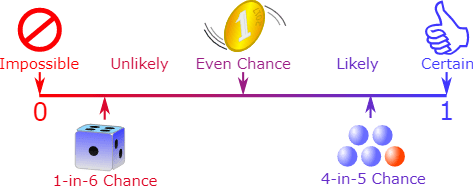
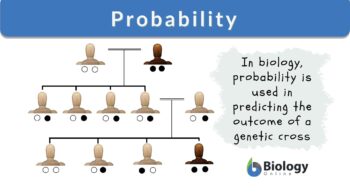
Probability is a measure of the likelihood of a statement or a theoretical expectation is correct. For instance, the probability is used to measure the chance or likelihood of an event to occur, a hypothesis being correct, or a scientific prediction being true. In biology, it is used in predicting the outcome of a genetic cross or of a random experiment.
The simplest example of probability is the flipping of a coin. Since a coin only has two sides, there are only two possible outcomes upon flipping, i.e., the coin will land up either with heads or tails. In this case, the chance of either outcome is 50% or 0.5 or 1/2. The formula for calculating the probability is given below.

Now, we are well versed with the definition of probability in biology. Let’s try to answer the question: Why is probability important?
Probability is important as it helps predict the chances of occurrence of an uncertain event. This prediction has widespread use across various fields such as science, biology, genetics, statistics, finance, gambling, artificial intelligence, machine learning, ecology, etc. The scope of this article remains limited to the use of probability in genetics and statistical biology.
Before we proceed further let’s first briefly have a look at the statistical version of probability.
How do you define probability in statistics? In statistics, probability, represented by the p-value, measures the likelihood of an observation made in a research study being false.
You must have observed the p-value of a study, it can tell you how reliable the study is. If a research study has a p-value of 0.05 it means that there is only a 5% chance that the observation made by the study is false. Conversely, there is a 95% chance that the observation made by the study is true. Generally, the lower the p-value of a study, the more reliable the study is. However, a p-value of 0.05 is generally considered acceptable worldwide.
What is Probability and How is it used in Genetics?
In genetics, probability is a measurement tool that helps us predict the chances of an offspring being inherited with a particular trait of interest. In diploid organisms, during the formation of gametes by the process of meiosis there is a 50% chance for each of the chromosomes to get passed on to the gamete. Hence, when fertilization occurs a variety of combinations of different alleles is possible resulting in different phenotypes. Let’s understand this concept with the help of an example.
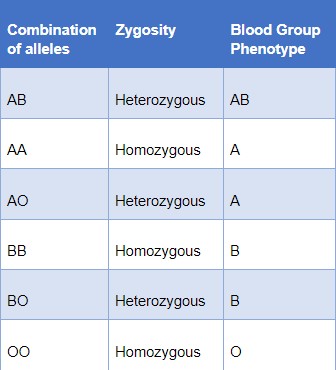
The phenotype of the blood group in humans is determined by the allelic combination that the offspring inherits. Table-1 shows the different possible allelic combinations with their respective phenotype.
Now, let’s assume that a heterozygous mother (AO) wants to bear a child with a heterozygous father (BO). Figure 3 shows the Punnett square of this cross.
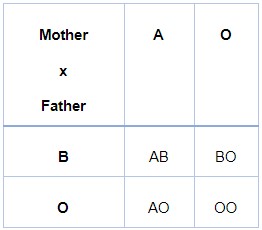
From the Punnett square, we can observe that the child can have 4 possible combinations each of which has an equal chance of occurrence i.e., ¼ or o.25 or 25%. Now, let’s assume that a homozygous mother (AA) wants to bear a child with a heterozygous father (BO). Figure 4 shows the Punnett square of this cross.
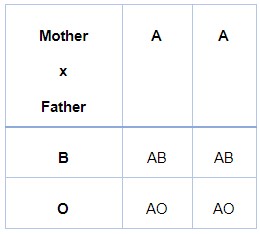
In this scenario, we can observe that there is a 50% chance of having either blood group A or blood group AB. However, there is no chance that the child can have a blood group B or O.
Rules of Probability in Genetics
Rules of probability are used to solve genetics’ probability problems. Some of the common rules of probability and heredity problems using these rules are presented below.
1) Product Rule: According to this rule, the probability of occurrence of two or more independent events together can be calculated by multiplying the probability of each of the individual events.
A couple wants to have 2 children. What is the probability of both the children being the boys?
Since the probability of a baby boy being born at each childbirth is 0.5. The probability of both the children being boys will be calculated as 0.5 x 0.5 which is 0.25 or 25%.
2) Sum rule: According to this rule, the probability of occurrence of any of the two or more mutually exclusive events can be calculated by adding the probability of each of the individual events.
What is the probability of getting either 1 or 2 upon rolling some dice?
Since the probability of getting 1 or 2 individually upon rolling some dice is 1/6. The probability of getting either 1 or 2 can be calculated by adding 1/6 + 1/6 which is 2/6 or 0.33 or 33%.
Probability Examples
The role of probability is extremely widespread. Let’s now take a look at certain examples where probability is used.
(1) Gender equality in nature
Probability plays an important role in gender equality. In most species, there is an equal 50% chance for the offspring to be of either gender. This equal probability is important for the maintenance of the stability of the populations.
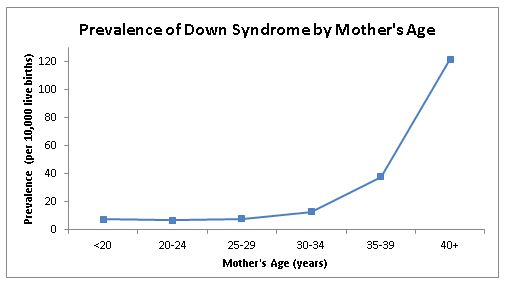
(2) Probability can be used to predict the expected frequencies of genetic diseases and malformations
For example, Down’s syndrome, which is due to the trisomy of chromosome 21 is expected to occur with a frequency of 1 in 1250 births when a mother conceives at an age of 25 years. The probability of occurrence of down’s syndrome increases drastically with increasing age. It can increase up to 1 in every 100 births when conceived at the age of 40 years.
(3) Pharmacological treatment efficacy
Let’s say a pharma company tests out a new drug X and claims that it is better than the previously used drug Y. The p-value of this study helps us to know whether the claim is reliable or not. The standard acceptable p-value of a study is 0.05. It means that there is a 95% chance that drug X is actually better than drug Y. Also, there is a 5% chance that the claim made can be false.
(4) Risks for a medical condition
In medical science, we use probability to evaluate the risk of a certain condition under specific circumstances. Smoking is associated with the cause of lung cancer. The specific increase in the risk of lung cancer caused by smoking can be predicted with the help of probability. The men who have a habit of smoking are 23 times more likely to develop lung cancer than the normal population.
(5) Research data analysis
When research is conducted, it may not be possible to conduct it on the entire population. Hence, it is mostly conducted on a sample that correctly represents the population of interest and then later the conclusions are drawn for the entire population. However, to draw the appropriate sample one needs to use the methods of probability where each individual gets an equal chance of selection.
Try to answer the quiz below to check what you have learned so far about probability.

Further Reading
References
- Kendall, M. G., Stuart, A., & Ord, J. K. (1987). Kendall’s advanced theory of statistics. New York: Oxford University Press.
- Feller, W. (1957). An introduction to probability theory and its applications. New York: John Wiley & Sons, Inc.
- Center of disease control and prevention, 06-Apr-2021, Facts about Down Syndrome.
©BiologyOnline.com. Content provided and moderated by Biology Online Editors.