Pinocytosis
n.
[ˌpaɪnəʊsaɪˈtəʊsɪs]
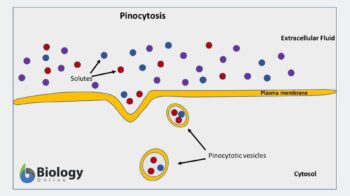
The process of cells to ingest extracellular fluids (ECF) or the surrounding fluid, but not very specific in the substances or dissolved particles that it absorbs. Also called “cell drinking”.
Source: Clare Brown, BiologyOnline.com
Table of Contents
Pinocytosis Definition
What is pinocytosis? Pinocytosis is the ingestion of extracellular fluids, i.e. the fluid surrounding the cell, together with its contents of small dissolved molecules (solutes). This begins with the cell forming narrow channels through its membrane that pinch off into vesicles, and fuse with endosomes resulting in the hydrolysis or breakdown of the contents. Pinocytosis can be thought of as ‘cell drinking’ as the word comes from the Greek “pino“, meaning ‘to drink’ and “cyto“, meaning ‘cell’. Pinocytosis was discovered by Warren Lewis in 1931 and is also known as fluid-phase endocytosis.
Pinocytosis is an example of endocytosis, a cellular process in which substances are brought inside a cell. Other types of endocytosis include phagocytosis and receptor-mediated endocytosis. All three are about taking in of substance into the cell. However, what is the difference between phagocytosis and pinocytosis? Phagocytosis is about “engulfing” a relatively larger substance. Conversely, pinocytosis refers to “cell drinking”.
As for the difference between pinocytosis and receptor-mediated endocytosis, the latter is more specific; substances have to bind to the receptors on the cell surface to initiate endocytosis. Nevertheless, some references classify the latter under the wider, broader, pinocytosis. The uptake of fluid from outside the cell that involves pinosomes (fluid-filled vesicles), irrelevant of the size, is what defines pinocytosis. Thus, for the purpose of being more inclusive, we have included the receptor-mediated types under pinocytosis as elaborated in detail in the next sections: Types of Pinocytosis.
Steps of Pinocytosis
What happens during pinocytosis? The membrane surrounding the cell can be described as semi-permeable. This means that it allows some molecules in or out via diffusion. The cell membrane also contains various lipids, fats, and protein channels/carriers.
Only small particles can be taken up during pinocytosis as they are usually dissolved in the extracellular fluid. The resulting vesicle contains this extracellular fluid complete with its solutes.
The vesicle can be described as a membrane-bound organelle; it is made up of the extracellular membrane of the cell enclosing the fluid in a spherical arrangement. Pinocytosis can be initiated by electrostatic interaction between a positively charged substance, such as the charged portion of a peptide or protein, and the negatively charged surface of the cell membrane. This can initiate binding to the cell membrane, altering the shape of the membrane to create a pouch around the fluid containing the charged peptide or protein.
Eventually, the membrane curls around on itself, and the pouch is ‘pinched off ‘ allowing the resulting vesicle to drift into the cytoplasm of the cell.
The pinocytotic vesicles function as carriers of the extracellular fluid into the cell. Let’s take a look at the steps involved in pinocytosis as shown in the diagram below.
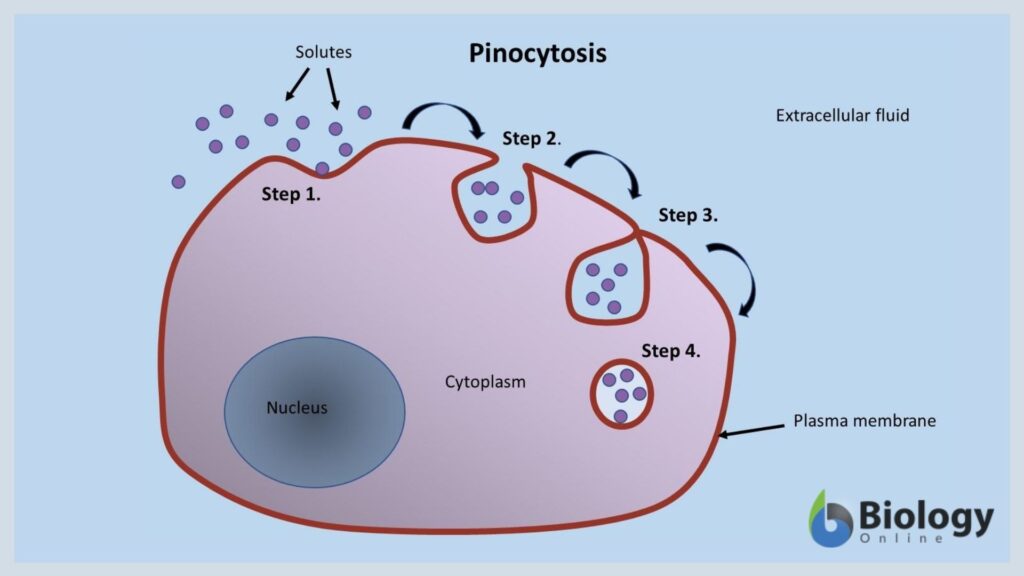
Step 1. A molecule in the extracellular fluid binds to the cell membrane which begins the pinocytosis process.
Step 2. This triggers the cell membrane to create a fold around the fluid containing the molecules to be ingested.
Step 3. The cell membrane invaginates (folds back on itself) to create a pouch.
Step 4. This pouch is then pinched off at the cell membrane and can migrate into the cytosol of the cell.
Source: Clare Brown of Biology Online.
Function of Pinocytosis
The main function of pinocytosis is to absorb extracellular fluids. It plays an important role in the uptake of nutrients along with the removal of waste products and signal transduction.
READ: Movement of Molecules Across Cell Membranes
Types of Pinocytosis
Pinocytosis can be divided by the size of the molecules to be taken up.
- Micropinocytosis refers to the uptake of small molecules with a vesicle size of around 0.1µm. Caveolin-mediated pinocytosis is a common example of micropinocytosis that will be described in more detail below.
- Macropinocytosis results in the formation of larger vesicles of around 0.5-5 µm. Macropinocytosis is a non-selective process. It results in the formation of large macropinosomes. The protein actin is largely involved in the formation of protrusions or ruffles in the cell membrane which results in the formation of these large vesicles. Macropinocytosis is used by immune cells such as macrophages to sample bulk extracellular fluid for soluble antigens that can evoke an immune response if necessary.
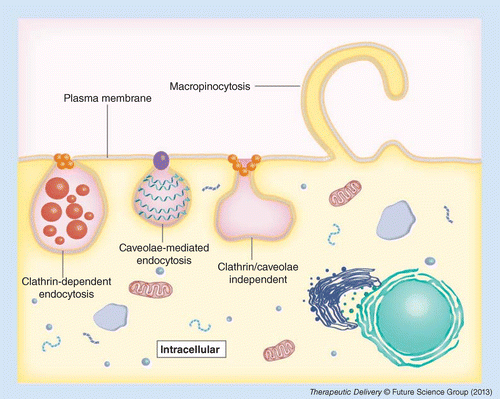
Pinocytosis can be further divided into 4 sub-types based on the mechanism of action. These are as follows:
- Macropinocytosis
- Clathrin-mediated endocytosis (also known as receptor-mediated endocytosis)
- Caveolae-mediated endocytosis
- Clathrin-independent/caveolae independent endocytosis.
The figure below shows these different processes.
Clathrin-mediated pinocytosis
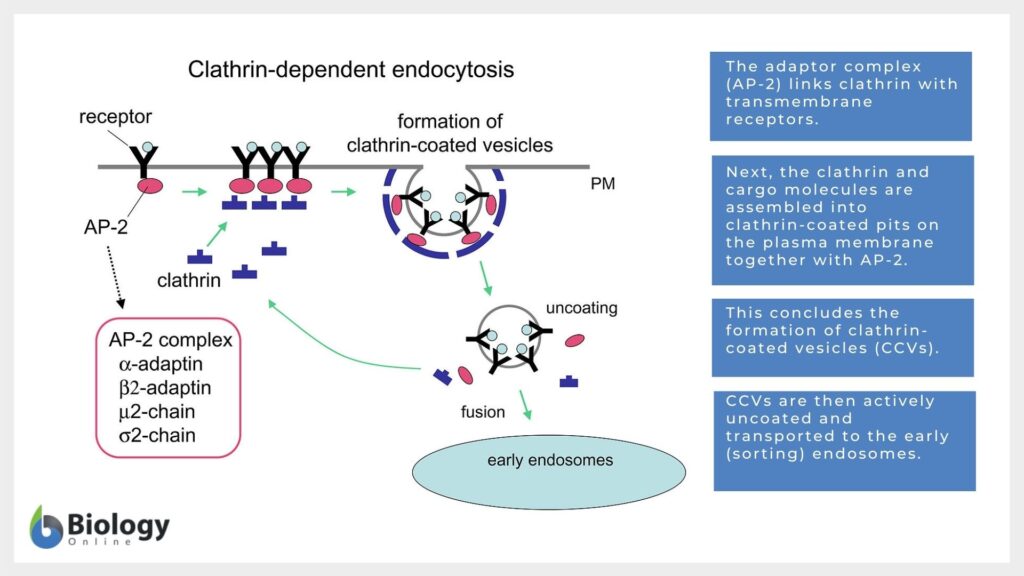
This type of endocytosis is important for many membrane-bound molecules and soluble molecules such as hormones, metabolites, or proteins. The process can be described as follows:
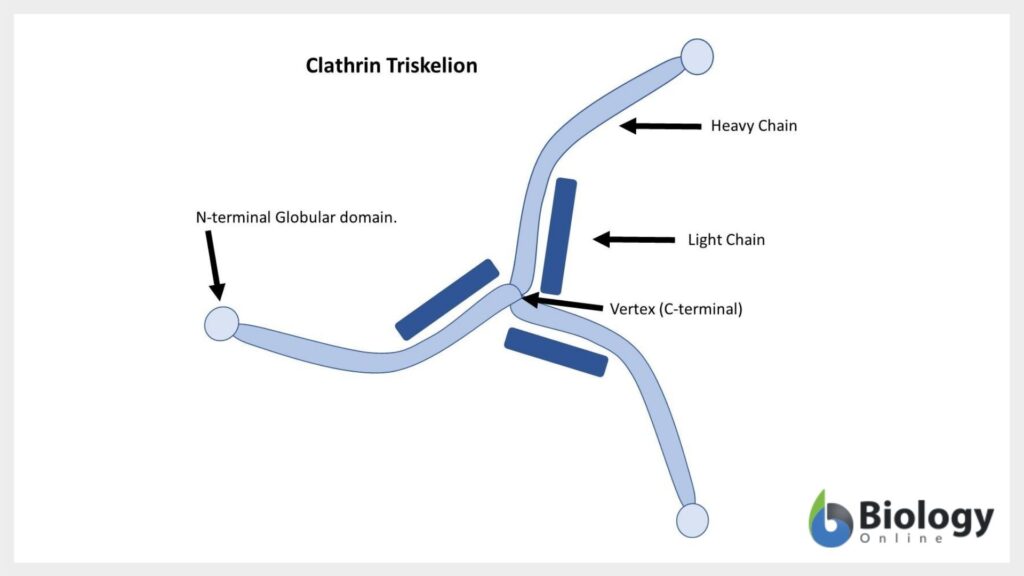
Macromolecules in the extracellular fluid can bind to receptors on the cell surface membrane. As a result, clathrin begins to polymerize around the cell membrane with the help of adaptor molecules. The clathrin molecule can be described as a 3-legged structure or a clathrin triskelion. It consists of a center point known as the vertex, a heavy chain, and a light chain separated by a ‘knee’ and a globular domain on the end of each leg (see figure below).
Adaptor proteins, also known as adaptins, form a layer in between the clathrin coating. Clathrin-coated vesicles consist of 3 different layers. The inner lipid membrane containing various proteins, an adaptor protein layer, and an outside layer of clathrin. The adaptor proteins are therefore able to interact with both the lipid and the clathrin layers.
The coated pits that form the vesicles are formed of clathrin and a large protein complex known as adaptor protein 2 (AP-2). These vesicles contain the macromolecules along with the bound corresponding receptors. When a clathrin-coated pouch forms, dynamin, a cytosolic protein polymerizes over the end of the pouch, sealing it off. This uses energy from GTP hydrolysis. The clathrin-coated vesicle is then able to fuse with an early endosome. As the early endosome becomes more acidic, the molecule detaches from the cell receptor and can be used by the cell. The cell receptor is left inside the endosome and is either transported back to the cell membrane or is transferred to late endosomes where it follows the pathway of lysosome degradation.
Clathrin-mediated endocytosis is the most studied type of endocytosis, with over 50 proteins that are thought to be involved with the formation of clathrin-coated vesicles.
Caveolae-mediated pinocytosis
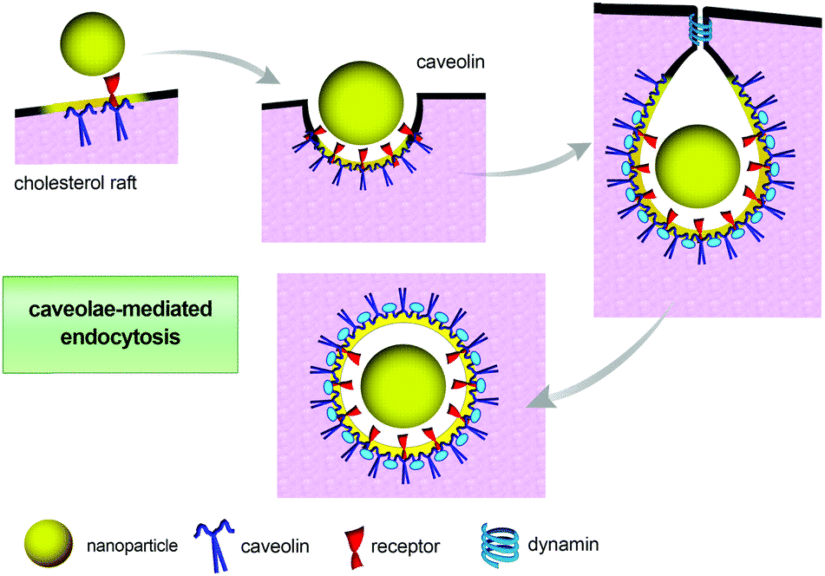
This type of pinocytosis occurs in adipocytes (fat cells) and endothelial cells. Discovered in the 1950s, the caveolae complex consists of lipids, sphingolipids, and proteins called caveolins and cavins. There are 3 types of caveolae proteins, these are CAV-1, CAV-2, and CAV-3. CAV-3 proteins are muscle-specific. There are 4 types of cavin proteins, these include, cavin1 (PTRF), cavin2 (SDPR), cavin3 (PRKCDBP), and cavin4 (MURC) which is muscle specific. Caveolae pits are rich in proteins and lipids. Most cell types contain caveolae. They are often described as flask or ‘cave’ shaped, however, their shape does vary depending on the physiology of the cell. Each caveolae molecule contains around 150 CAV-1 molecules and around 50 cavin molecules.
Caveolae are generally immobile in the plasma membrane but if a receptor is activated, they can bud off from the plasma membrane (see figure below). Caveolae can detach from the plasma membrane to form vesicles. Studies have shown that some bud off the plasma membrane, only to fuse back with it, whereas others move to the early endosome and then return to the plasma membrane. The enzyme dynamin is the main protein involved in sealing off the neck by interacting with CAV-1. Caveolae are thought to be involved in the transport of albumin across the cell. It has also been discovered that some pathogens use the caveolae-mediated pinocytosis to enter cells and avoid the endosome-lysosome pathway such as Simian Virus 40 (SV40).
Clathrin and caveolae-independent pinocytosis
This process of pinocytosis works independently of receptors or other material stimuli. It does not require coat proteins for the formulation of vesicles. Actin and other related proteins are vital in this pathway for vesicle formation. Cargo can be delivered to early endosomes to follow the late endosome pathway to the lysosome. It can also be sent to the Golgi network or sent back to the plasma membrane for recycling.
Examples of Pinocytosis
What are examples of pinocytosis? In eukaryotic cells, pinocytosis is used widely, from the transport of dissolved fats (e.g. low-density lipoprotein) and vitamins to the removal of waste materials via the kidney cells. It is used by cells of the immune system to check the extracellular fluid for antigens (toxins or foreign substances). It can also be seen in the microvilli of the digestive system. Interestingly, flu viruses can use certain methods of pinocytosis to gain entry to cells as can some bacterial toxins.
Pinocytosis vs Phagocytosis
Both pinocytosis and phagocytosis use energy (ATP). However, there are many differences between pinocytosis and phagocytosis (see table below). Phagocytosis is performed mainly by immune cells such as monocytes/macrophages as well as neutrophils and dendritic cells. Where does pinocytosis occur? Pinocytosis, on the other hand, occurs in most cell types. Phagocytosis takes up larger solid materials such as bacteria, to be broken down rather than liquids that have already been dissolved. Phagocytosis is a process that forms phagosomes ingesting 1-2 µm particles as opposed to 0.1 – 0.2 µm particles taken up by pinosomes in pinocytosis. Furthermore, phagocytosis is a triggered process in comparison to a constant process, as seen in pinocytosis. Finally, phagocytosis involves the formation of pseudopodium (protrusions on the cell surface) before the phagosome is formed.
| Pinocytosis | Phagocytosis |
|---|---|
| Ingestion of liquid by vesicles called pinosomes | Ingestion of solids by phagosomes |
| Constant process | Triggered process |
| 0.1-0.2µm particles ingested | 1-2µm particles ingested |
| Occurs in almost all cells | Occurs mostly in immune cells |
Try to answer the quiz below to check what you have learned so far about pinocytosis.

References
- Archarya, P.C., et al. (2018). Dosage Form Design Considerations. Physiological Factors Associated to Drug Absorption. (4) 117-147. https://doi.org/10.1016/B978-0-12-814423-7.00004-6
- Branza-Nichita, N., Macovei, A. Lazar, C. 2012. Caveolae-Dependent Endocytosis in Viral Infection. Molecular Regulation of Endocytosis. https://doi.org/10.5772/48538
- Brown, D.A. (2013) Lipid Rafts. Encyclopedia of Biological Chemistry. 741-744
- Charoo, M.A., Rahman, Z. Khan, M.A. (2019). Nanoparticles for improvement in bioavailablity. Nanoarchitectonics in Biomedicine. (11) 371-410. https://doi.org/10.1016/B978-0-12-816200-2.00006-2
- Kaksonen, M., Roux, A. Mechanisms of clathrin-mediated endocytosis. Nat Rev Mol Cell Biol 19, 313–326 (2018). https://doi.org/10.1038/nrm.2017.132
- Kiss, A. L., & Botos, E. (2009). Endocytosis via caveolae: alternative pathway with distinct cellular compartments to avoid lysosomal degradation? Journal of Cellular and Molecular Medicine, 13(7), 1228–1237. https://doi.org/10.1111/j.1582-4934.2009.00754.x
- Mayor, S., Parton, R. G., & Donaldson, J. G. (2014). Clathrin-independent Pathways of Endocytosis. Cold Spring Harbor perspectives in biology, 6(6), a016758. https://doi.org/10.1101/cshperspect.a016758
- Palm W. (2019). Metabolic functions of macropinocytosis. Philosophical transactions of the Royal Society of London. Series B, Biological sciences, 374(1765), 20180285. https://doi.org/10.1098/rstb.2018.0285
- Panawala, L. (2017). Difference between phagocytosis and pinocytosis. ResearchGate. https://www.researchgate.net/publication/315829783_Difference_Between_Phagocytosis_and_Pinocytosis
- Pino. Wordquests. http://wordquests.info/cgi/ice2-for.cgi?file=/hsphere/local/home/scribejo/wordquests.info/htm/d0001675.htm&HIGHLIGHT=of
- Popova, N. V., Deyev, I. E., & Petrenko, A. G. (2013). Clathrin-mediated endocytosis and adaptor proteins. Acta naturae, 5(3), 62–73.
- Sapkota, A. (2020). Pinocytosis, definition, steps, types, examples, (vs Phagocytosis). Microbe Notes. https://microbenotes.com/pinocytosis/#:~:text=The%20process%20of%20pinocytosis%20begins,extracellular%20fluid%20to%20be%20absorbed.
- Sheil, W.C. Medical Definition of Cyto. MedicineNet. https://www.medicinenet.com/script/main/art.asp?articlekey=19885
- Sorkin A., Puthenveedu M.A. (2013) Clathrin-Mediated Endocytosis. In: Yarden Y., Tarcic G. (eds) Vesicle Trafficking in Cancer. Springer, New York, NY. https://doi.org/10.1007/978-1-4614-6528-7_1
- Swanson. J.A., Yoshida.S. (2016). Macropinocytosis. Encyclopedia of Cell Biology. (2) 758-765. https://doi.org/10.1016/B978-0-12-394447-4.20084-9
- Thomas, C. M., & Smart, E. J. (2008). Caveolae Structure and Function. Journal of Cellular and Molecular Medicine, 12(3), 796–809. https://doi.org/10.1111/j.1582-4934.2008.00295.x
- What is Caveolae Endocytosis. MBInfo Defining Microbiology. https://www.mechanobio.info/what-is-the-plasma-membrane/what-is-membrane-trafficking/what-is-caveolar-endocytosis/
- What is Clathrin-mediated Endocytosis? MBINFO. https://www.mechanobio.info/what-is-the-plasma-membrane/what-is-membrane-trafficking/what-is-clathrin-mediated-endocytosis/#:~:text=Clathrin%2Dmediated%20endocytosis%20(CME),synaptic%20vesicle%20reformation%20%5B1%5D.
- Xin, H., Jiang, Y., Lv, W., Xu, J. (2018). Liposome-Based Drug Delivery for Brain Tumour Theranostics. Nanotechnology-Based Targeted Drug Delivery Systems for Brain Tumors (9) 245-266. https://doi.org/10.1016/B978-0-12-812218-1.00009-9
©BiologyOnline. Content provided and moderated by BiologyOnline Editors.