Mutation
n., plural: mutations
[mjuˈteɪʃən]
Definition: change in the nucleotide sequence, which the system is not able to repair and revert
Table of Contents
A mutation is a permanent, heritable change in the nucleotide sequence or the process by which such a change occurs in a gene or in a chromosome.
There are two major types of mutations: small-scale and large-scale. Small-scale mutations are genetic mutations, often in the form of substitutions, deletions, and insertions of one or more nucleotides. Mutations occurring in certain areas of chromosomes are large-scale mutations. This form of mutation can be lethal or result in serious conditions or syndromes.
Mutation Definition
Mutation in general means a change or the process of changing, such as in nature, form, or quality. In biology, mutation refers to any change in the nucleotide sequence as a result of a failure of the system to revert the change. Thus, the altered sequence is permanent and heritable.
Etymology: The term mutation came from Latin mutationem, mūtō, meaning “I move” or “I change”.
Watch this vid about mutations:
Types of Mutations
A mutation is a change in the nucleotide sequence of a gene or a chromosome. Based on the effect of mutation on the gene structure, mutations are (1) small-scale or (2) large-scale.
- Small-scale mutations are a type of mutation where one or a few nucleotides of a gene are affected.
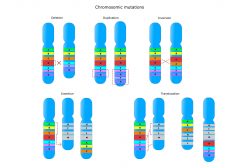
- A large-scale mutation is a chromosomal mutation, e.g. deletion, inversion, or amplification of a region of a chromosome.
A. Small-scale
Small-scale mutations affect one or a few nucleotides of a gene. These are further classified into substitution mutation, insertion mutation, and deletion mutation. Substitution mutation is when a nucleotide is substituted with a different nucleotide.
Examples of (base-pair) substitutions are as follows:
- A purine is substituted with a different purine (A → G)
- A pyrimidine replaced by a different pyrimidine (C → T)
- A purine is substituted with a pyrimidine
- A pyrimidine is replaced by a purine
The first two examples are the types of transition (mutation). The last two are examples of transversion.
Substitution mutation is sometimes referred to as point mutation, i.e. when the gene mutation involves only one nucleotide.
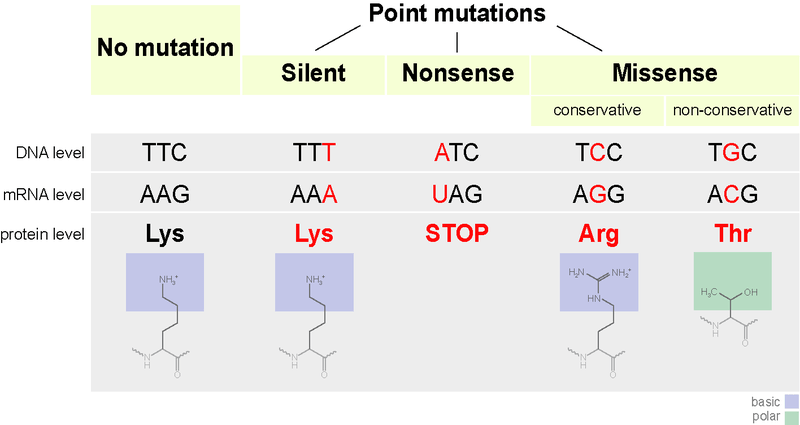
Point mutations may further be classified based on the impact on the resulting protein:
- Frameshift mutation
- Nonsense mutation
- Missense mutation
- Neutral mutations
- Silent mutation
A frameshift mutation is a type of gene mutation wherein the addition or deletion of (a number of) nucleotide(s) causes a shift in the reading frame of the codons in the mRNA. This leads to the alteration in the sequence of amino acids during protein translation.
A nonsense mutation is a form of mutation producing a nonsense codon. A nonsense codon, as the name implies, does not code for amino acid and it leads to a protein product that is early truncated.
A missense mutation results in a codon that specifies a different amino acid, and thus, causes the synthesis of a protein with an altered amino acid sequence during translation.
A neutral mutation has no selective advantage or disadvantage.
A silent mutation is when the codon codes for the same amino acid and therefore produces neither structural nor physiological change in the protein product.
B. Large-scale
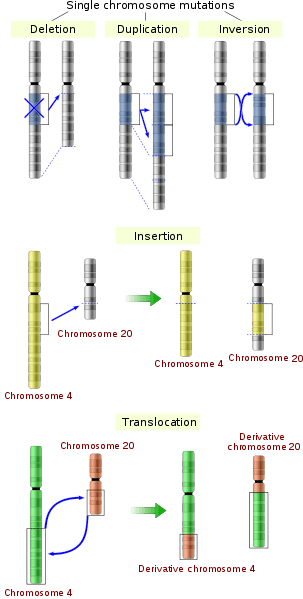
Large-scale mutations involve a change in the chromosome. They are classified further into amplifications (also referred to as gene duplications), deletions of large chromosomal regions, and chromosomal inversions.
Causes of Mutations
Mutations may arise from faulty deletions, insertions, or exchanges of nucleotides in the genetic material. These, in turn, may be caused by exposure to mutagens, such as ultraviolet or ionizing radiation, certain chemicals, and viruses. When a point mutation occurs in the DNA sequence, for instance, the error is corrected or repaired by direct reversal or by the replacement of damaged nitrogenous bases. When these mechanisms fail to restore the integrity of the sequence, the result is a mutation that is permanent and heritable. The error is propagated by DNA replication, i.e. a biological process of copying a strand of DNA.
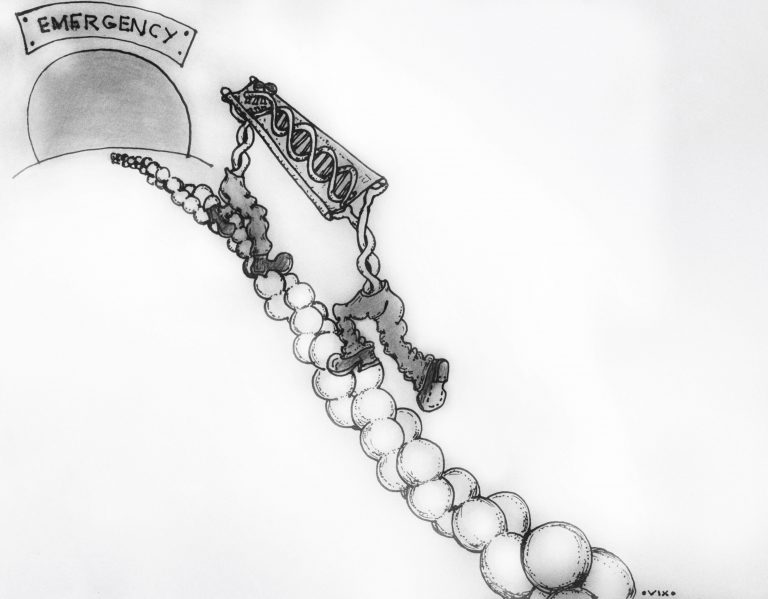
“Emergency! DNA Damage!“
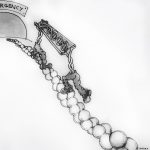
A recent study on the DNA repair mechanism of the cell suggests likened the process to a team of paramedics — myosins — that bring the damaged DNA to an emergency room –the nuclear pore.
(Recall that the nucleus has a nuclear membrane that has pores) Accordingly, broken DNA strands initiate a series of threads — nuclear actin filaments — to assemble and form a “road” that links to the edge of the nucleus. The myosin (i.e. a protein conveyed to be “walking” because of the presence of “two legs”) takes this path as it carries the injured DNA strand towards the nuclear pore for DNA repair.
Read more here: How cell fixes DNA damage
Effects of Mutations
Mutation results in the formation or creation of a new character or trait. This new trait may be advantageous or deleterious. Evolutionary speaking, mutations are vital as they introduce new traits in a population, change allele frequencies, and include changes in the DNA sequences.
The DNA in the genes carries the genetic code that specifies base pairs. This, in turn, specifies the sequence of amino acids in a polypeptide or protein during the translation of the mRNA transcript.
Proteins are one of the major biomolecules that have multifarious functions. Some of them serve as structural components, others act as enzymes. When their structure is altered they may not be able to function as they should and this could lead to serious effects, like genetic disorders and syndromes.
An organism, gene, or chromosome that is different from the wild type due to mutation(s) is referred to as a mutant. Carrying the mutation, the organism could transmit the new trait across generations.
Examples
Examples of mutations in animals are those born with extra body parts, e.g. two-headed snakes, four-legged ducks, and a cyclops kitten. Often, these kinds of mutations lead to the death of the animal soon or a few days after its birth.
In humans, genetic disorders are often due to a mutation involving an altered gene or chromosomal aberration. Sickle-cell disease, for instance, occurs when the 20th nucleotide of the gene for the beta chain of hemoglobin on chromosome 11 is changed from the codon GAG to GTG so that when translated the 6th amino acid is now a valine instead of glutamic acid.
Other common mutation examples in humans are Angelman syndrome, Canavan disease, color blindness, cri-du-chat syndrome, cystic fibrosis, Down syndrome, Duchenne muscular dystrophy, haemochromatosis, haemophilia, Klinefelter syndrome, phenylketonuria, Prader–Willi syndrome, Tay–Sachs disease, and Turner syndrome.
In plants, mutations are exemplified by those bearing chimera, sports, or breaks. They are naturally occurring and can cause changes in the appearance of the foliage, flowers, fruit, or stems of any plant.
Take the Mutation Biology Quiz!

References
- Genetics Home Reference. (2019). What is a gene mutation and how do mutations occur? Retrieved from Genetics Home Reference website: https://ghr.nlm.nih.gov/primer/mutationsanddisorders/genemutation
- Petr H. (2019, May 8). 25 Surprisingly Real Life Animal Mutations. Retrieved from List25 website: https://list25.com/25-surprisingly-real-life-animal-mutations/
- Mutation examples and how they happen. (2019). Retrieved from Agriculture website: https://www.canr.msu.edu/news/mutation-examples-and-how-they-happen
- Mutations: plant / RHS Gardening. (2019). Retrieved from Rhs.org.uk website: https://www.rhs.org.uk/advice/profile?pid=259
- DNA and Mutations. (2019). Retrieved from Berkeley.edu website: https://evolution.berkeley.edu/evolibrary/article/mutations-01
- What is a Mutation? (2019). Retrieved from Utep.edu website: http://utminers.utep.edu/rwebb/html/what_is_a_mutation_.html
- Mutation. (2019). Retrieved from Mit.edu website: http://web.mit.edu/saraht/Public/8.592FinalProject/Population_genetics/Mutation.html
© Biology Online. Content provided and moderated by Biology Online Editors