|
|
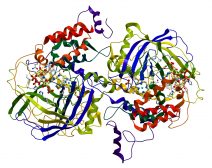
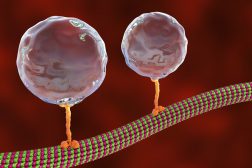
Dictionary » L » Ligand LigandDefinition noun, plural: ligands (1) A molecule, ion or atom bonded to the central metal atom of a coordination compound. (2) Any substance (e.g. hormone, drug, functional group, etc.) that binds specifically and reversibly to another chemical entity to form a larger complex.
A ligand may function as agonist or antagonist. Many ligands are found in biological systems, such as cofactors and porphyrin in hemoglobin.
Related term: ligand gated ion channels ![]()
Please contribute to this project, if you have more information about this term feel free to edit this page ![]()
Results from our forumInsulin signaling... in the pancreas. This stimulates the islets to produce insulin that is then secreted into the blood and travels thru out the body. Insulin is a ligand for the insulin receptors that are found on the outside of many cells. Once the insulin binds to this receptor, it initiates a phosphorylating ...
See entire post
Re: endorphins... for any endorphin at Protein Data Bank. Nothing for opioid receptor, either. Obviously the functional tertiary structure of an endorphin is in the ligand-receptor complex. Regards, Paul
See entire post
Creating Cell Lines... you should try to knock it out. You need a stable cell line though. That is a big project. But many times, you get multiple receptors for one ligand. siRNA could be used for silencing.
See entire post
How does a mutated gene affect Tyrosine Kinase?I believe you are correct, in both instances the signal transduction would be inhibited. 1) the receptor is not able to bind the ligand properly, therefore no conformational change would occur 2) the receptor bound the ligand, but the lack of intracellular domain stopped the further transduction ...
See entire post
I need answers to the following questions...... one time, existed in the lumen of the endoplasmic reticulum? a. the kinase region b. the regions which ultimately can interact with the receptor's ligand (hormone, etc.) c. the transmembrane (membrane spanning) region. d. all of the above e. none of the above. 7. Which of the following statements ...
See entire post
This page was last modified 00:30, 22 March 2009. This page has been accessed 9,542 times. |
© Biology-Online.org. All Rights Reserved.
Register | Login
| About Us | Contact Us | Link to Us | Disclaimer & Privacy
Science Network - Braintrack.com - University Directory | Chemicool.com - Chemistry