Definition: two members of a pair of alleles separate during gamete formation
Table of Contents
Mendel’s Laws of Inheritance
The father of genetics, Gregor Mendel, reported his findings in 1860 that initially were unpopular during his time but eventually gained traction and became so widely accepted that his findings paved the way for the founding of the science of genetics. Three different laws of inheritance were formulated based on his experimentation with pea plant reproduction. His experiments explained the transfer of genetic traits from one generation to the next. These laws have significantly expanded the understanding of genetic inheritance and resulted in new experimental methods becoming developed.
Three Different Mendel inheritance laws are as follows:
- Law of Segregation
- Law of Independent Assortment
- Law of Dominance
Law of Segregation – Biology Definition
Question: What is the law of segregation?
Answer: It is also called the first law of inheritance. The law of segregation states that:
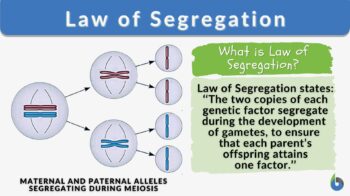
‘‘The two copies of each genetic factor segregate during the development of gametes, to ensure that each parent’s offspring attains one factor.’’
OR
‘‘During the development of the gamete, each gene is segregated in such a way that the gamete consists of just one allele for that gene.’’
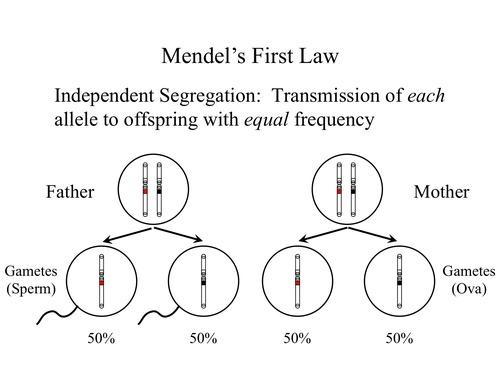
The copies of a gene are segregated when any individual produces gametes so that each gamete accepts only one copy. One allele is received by a gamete.
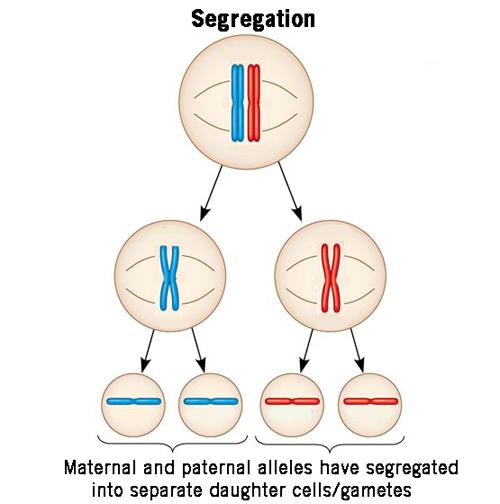
The exact proof of this was later discovered as the process of meiosis was understood. In meiosis, the mother’s and the father’s genes are separated, and so the character alleles are separated into two distinct gametes.
Difference between allele and gene
A gene is an essential part of the DNA that defines a specific trait; an allele is a specific form of a gene. The expression of traits is the key role of the genes. Alleles are important for the variations in which the trait can be expressed.
What is segregation?
Segregation is the separation of allele pairs (different traits of the same gene) during meiosis so that they can transfer specifically to separate gametes.
Why is Mendel’s Law of Segregation defined as the purity law of gametes?
In genetics, the Law of Segregation shows that a gamete carries either a recessive or a dominant allele but not both alleles at the same time. This is the reason this law is also known as the law of purity of gametes.
The segregation law is Mendel’s first law. It states that during meiosis alleles segregate. The fundamental principles of this law are posited as follows:
- There can be more than one type of allele for a gene.
- During the process of meiosis, when gametes are formed, the allele pairs segregate, i.e. they separate.
- For the determination of a Mendelian trait, two alleles are involved — one is recessive and the other is dominant.
Even without influencing each other, they stay together in pure form. They don’t mix or blend. Therefore the segregation law is also known as the law of purity of gametes for this reason. During the formation of gametes, the segregation of two alleles of a gene usually occurs because of the segregation of homologous chromosomes during meiosis. Tetrads (where each tetrad consists of four chromatids of a homologous pair that form by synapsis) separate during anaphase I, and then sister chromatids of homologous chromosomes separate during anaphase II.
A gamete is a cell, which is involved in fertilization. The egg and sperm are the female and male gametes in humans, respectively. Human eggs contain only one type of sex chromosome, i.e. X chromosome. Human sperm cells contain either X or Y chromosome. This determines the sex of the offspring. Under the segregation law, for any characteristic, including the dominant or recessive trait, a gamete will receive one of the two alleles.
Example
The alleles for a Mendelian trait may either be dominant or recessive and may be passed down from parent to child (animal or plant). In plants, for example, the color trait of the flower will depend on the type of allele inherited by the offspring. Each parent plant transfers one of the alleles to their offspring. And these sets of alleles in the offspring will depend on the chromosomes of the two gametes uniting at fertilization. These two sets of chromosomes are randomly segregated during gamete formation (wherein meiosis is a part of the process).
Principle of Segregation and its Importance
The principle of segregation defined that the individual has two alleles for each particular characteristic, and during the development of gametes, these alleles become segregated. In other words, there is one allele in each gamete. The principle of segregation is vital because it describes how genotypic ratios are produced in the haploid gametes.
Where does the law of segregation occur in meiosis?
Mendel’s Segregation law occurs in anaphase (I and II) of meiosis. It is a phase in the first meiotic division in which the homologous chromosomes are segregated into two daughter nuclei with their various versions of each gene. During meiosis, the behavior of homologous chromosomes can contribute to the separation of the alleles into distinct gametes for each genetic locus. When chromosomes divide during meiosis into various gametes, the two distinct alleles for a single gene often segregate such that one of the two alleles is obtained by each gamete.
Why is the Law of Segregation universally accepted?
The Law of Segregation is a universally accepted law of inheritance because it is the only inheritance law that has no exceptions while the other two laws have some exceptions. It states that each gene consists of two alleles that differ during the development of gametes, one allele from both mother and father, combines during fertilization.
Law of Independent Assortment
Also called the second inheritance law, it states that:
‘‘Separate couples with alleles are transferred separately from each other to the next generation. As a result, gene inheritance does not influence gene inheritance somewhere else at one position in the genome.’’
OR
‘‘This law described that alleles of various genes that are distributed during gamete development assort independently of each other.’’
This law is valid for those traits that are not related to each other such as seed color and seed shape. When an individual inherits two or more characteristics, those characteristics are assorted independently during the production of gametes. This gives the different traits an equivalent probability of occurring together. This indicates that the inheritance of one character will not influence the inheritance of the other.
Explanation
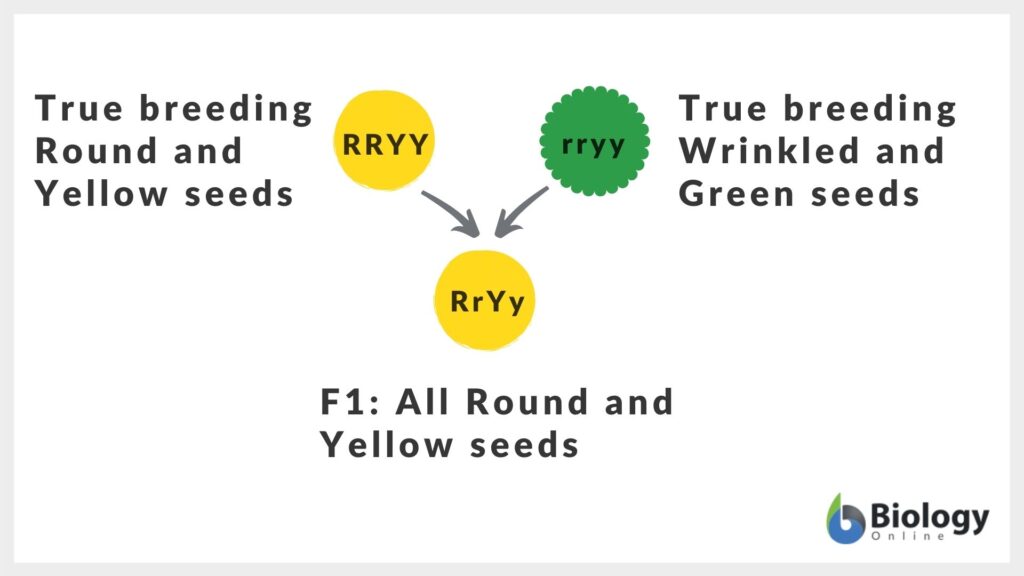
When two sets of Mendelian traits are fused into a hybrid, one pair of traits differs from the other pair of traits. Therefore, it means the alleles are independent and do not affect the other alleles. For example, a pea plant with round and yellow shape seeds was cross-pollinated with a plant with wrinkled green shape seeds.
When does this process occur?
While crossing over occurs in Prophase I, independent assortment law can be observed during metaphase I and anaphase I of meiosis. In metaphase, for instance, the chromosomes line up along the metaphase plate in a random orientation.
During meiosis, gamete cells are the final product. Gamete cells are referred to as haploid cells and also have half the regular diploid cell DNA. It is a vital aspect of reproduction that enables the cells of gametes to fuse to form a diploid zygote, carrying the information of DNA that is required for the development of offspring and a chromosomal number that is maintained across generations.
Principle of Independent Assortment
Independent assortment principles describe that during the development of gametes, allele pairs are segregated, which means that the traits are passed to the offspring independently of one another.
Importance of the Law of Independent Assortment
It is important for different genetic variations in organisms. For instance, the gene or alleles coding for a trait segregates independently from the gene or alleles coding for another trait during the development of gametes. It is also essential for the production of new genetic variations that enhance the genetic diversity within the population.
Law of Independent Assortment and Segregation Law: Similarities
- Both of them have a role in the Mendelian inheritance pattern.
- The inheritance of the alleles is illuminated by both the first and second laws of Mendel.
- Both laws are useful for increasing the variation among different individuals inside the populations.
Law of Segregation and Independent Assortment Law: Dissimilarities
Segregation Law: Mendel described that during the production of gametes, two copies of each genetic factor are distinct from each other. The non-homologous chromosomal activity is defined by the law of segregation.
Independent Assortment law: The law is defined that during the production of gametes, the genetic factors of an individual assembled autonomously when two or more factors are inherited. The activity of alleles is defined by this law.
Mendel’s Law of Dominance
Mendel’s Law of Dominance states that:
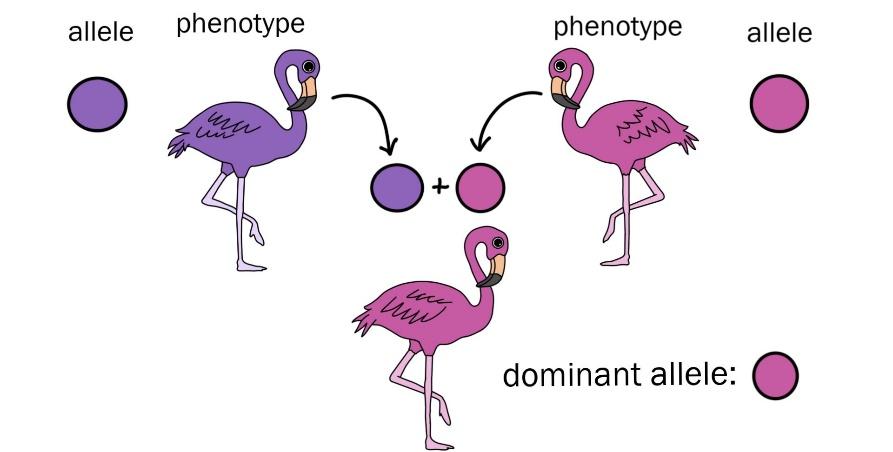
‘‘Only one sort of the trait will show in the next generation in a cross of parents which are pure for different traits. In the allele, children that are hybrid for a trait will only show the dominant characteristic, and children that are not hybrid for a trait will show recessive traits.’’
OR
‘‘It is stated that one factor in pair of traits dominates while the other remains suppressed in inheritance unless the two factors in the pair are recessive. In the next generation of parents who are pure for contrasting traits, there will be only one type of trait.’’
Explanation
The recessive allele that is suppressed will remain “dormant”. Nevertheless, it will be transferred to the next generation in the same way as the dominant allele is transferred. The suppressed trait shall be expressed only by the progenies having two copies of the allele. Also, these offspring can breed true when crossed by themselves.
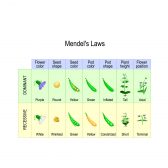
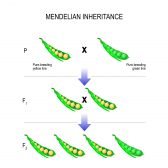
When Mendel crossed his pea plants several times, he found that all new pea plants (F1) were tall when he crossed both pure tall and short plants. Similarly, yellow-seeded pea plants (F1) were also produced through the crossing of both pure yellow-seeded and green-seeded pea plants.
When an allele is dominant, what does it mean?
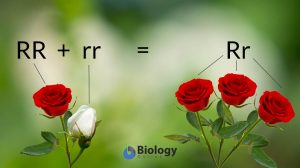
The dominant allele refers to the allele, which shows the physical expression (visible) on the human body because of its dominance. They demonstrate their effect even if there is only one allele copy for the individual. For example, between the yellow-flower trait and the white-flower trait, the trait that shall manifest in a hybrid progeny is construed as dominant and the allele coding for that trait is the dominant allele. The absence of the dominant allele will result in the expression of the recessive allele. Thus, the progeny with the dominant allele will manifest the dominant trait, e.g. yellow flowers, whereas those lacking the dominant allele will manifest the recessive trait, e.g. white flower.
Traits in human beings
There are more than 200 traits that are transferred to humans from generation to generation. These fascinating features of human genetics are recognized as hereditary traits. These genetic traits include dominant and recessive traits.
Difference between dominant and recessive traits
Dominant trait
- The dominant trait is defined as the trait that shows first or is visibly expressed in the individual.
- Examples are dwarfism, high blood pressure, baldness (in the male), excess body hair, and six fingers.
- A dominant trait is represented by capital letters, e.g. AA or BB.
Recessive trait
- The trait which is present at the level of the genome but is hidden and does not express in the organism is a recessive trait.
- Examples are normal growth, normal blood pressure, not bald, little body hair and five fingers normal
- A recessive trait is represented in small letters like aa or bb.
Any physical, emotional, psychological, and health trait shown by a human is due in part to the expression of genes. Genes are passed down from the parents to the offspring.
Why are these Mendelian laws not universally applicable?
Law of independent assortment and Law of dominance governing inheritance are not always applicable because there are traits that do not conform to Mendel’s inheritance pattern. These traits are referred to as non-Mendelian. Examples of such traits are those involved in polygenic inheritance or multiple alleles, codominance, and incomplete dominance.
The law of independent assortment is not universally applicable, in particular, because some alleles tend to be inherited together. Examples are sex-linked traits. They explain why some traits are commonly found in either male or female.
Biological Importance of Mendel’s Laws
Mendel’s laws have practical value in the breeding of different plants and animals because, through hybridization, desired types of plants and animals can be produced. In a single individual variety, the desired characteristics carried in different combinations can be coupled and maintained.
Cross hybridization has led to the development of several new disease-resistant and high-yielding crop production and decorative plant varieties, which is possible due to Mendel’s segregation law and independent assortment law.
The lecture below explains Gregor Mendel’s law of segregation and the law of independent assortment. These are two rules of genetics that explain the segregation of maternal and paternal genes during gametogenesis. Credit: Shomu’s Biology
Try to answer the quiz below to check what you have learned so far about the Law of Segregation.


|
MENDEL’S PRINCIPLES OF HEREDITY – QUIZ
Print this quiz for your students to answer. The first part is a recall of Gregor Mendel’s principles of heredity. The second part is a multiple-choice test about alleles and sex chromosomes. Subjects: Genetics & Evolution |
Further Reading
References
1. Chapter 3 and 4 Flashcards | Quizlet. (2014). Quizlet. https://quizlet.com/35583931/chapter-3-and-4-flash-cards/#:~:text=In%20other%20words%2C%20one%20allele,the%20haploid%20gametes%20are%20produced.&text=How%20are%20Mendel’s%20principles%20different,inheritance%20discussed%20in%20Chapter%201%3F
2. Law of Independent Assortment (Mendel): Definition, Explanation, Example. (2019). Sciencing. https://sciencing.com/law-of-independent-assortment-mendel-definition-explanation-example-13718436.html
3. Socratic, What is Mendel’s law of independent assortment? (2018, February 17). What is Mendel’s law of independent assortment? | Socratic. Socratic.org. https://socratic.org/questions/5a1dd296b72cff1817af3290#553051
4. Genetics Generation. (2012). Genetics Generation. https://knowgenetics.org/mendelian-genetics/
5. Beck, K. (2019). Law of Independent Assortment (Mendel): Definition, Explanation, Example. Sciencing. https://sciencing.com/law-of-independent-assortment-mendel-definition-explanation-example-13718436.html
6. O’Neil, D. (2012). “Basic Principles of Genetics: Mendel’s Genetics.” Basic Principles of Genetics: Mendel’s Genetics. http://anthro.palomar.edu/mendel/mendel_1.htm
7. Hartwell, L. H., Goldberg, M. L., Fischer, J. A., & Hood, L. (2017). Genetics: From genes to the genome. Columbus: McGraw-Hill Higher Education.
8. Pierce, B. A. (2017). Genetics: A conceptual approach. New York: W.H. Freeman. Snustad, D. P., & Simmons, M. J. (2015). Principles of genetics. New Jersey: Wiley.
9. Watson, J. D., Baker, T. A., Stephen, P. B., Alexander, G., Michael, L., & Richard, L. (2013). Molecular biology of the gene. London: Pearson
10. Bailey, Regina. “The 4 Concepts Related to Mendel’s Law of Segregation.” ThoughtCo. N.p., n.d. Web. Available here. 10 Aug. 2017. “Mendels Law of Independent Assortment – Boundless Open Textbook.” Boundless. N.p., 26 May 2016. Web. Available here. 10 Aug. 2017.
11. An Overview on Law Of Segregation and Law Of Dominance. (2020). Retrieved 13 November 2020, from https://byjus.com/biology/law-of-segregation-law-of-dominance/
©BiologyOnline.com. Content provided and moderated by Biology Online Editors.