Dictionary » I » Insect

Insect

Insect

1. (Science: zoology) One of the Insecta; especially, one of the hexapoda. See insecta.

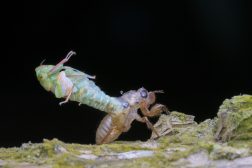
The hexapod insects pass through three stages during their growth, viz, the larva, pupa, and imago or adult, but in some of the orders the larva differs little from the imago, except in lacking wings, and the active pupa is very much like the larva, except in having rudiments of wings. In the higher orders, the larva is usually a grub, maggot, or caterpillar, totally unlike the adult, while the pupa is very different from both larva and imago and is inactive, taking no food.

2. (Science: zoology) Any air-breathing arthropod, as a spider or scorpion.

3. (Science: zoology) Any small crustacean. In a wider sense, the word is often loosely applied to various small invertebrates.

4. Any small, trivial, or contemptible person or thing. Insect powder,a powder used for the extermination of insects; especially, the powdered flowers of certain species of pyrethrum, a genus now merged in Chrysanthemum.

Synonym: persian powder.

Origin: F.insecte, L. Insectum, fr. Insectus, p.p. Of insecare to cut in. See section. The name was originally given to certain small animals, whose bodies appear cut in, or almost divided. Cf. Entomology.


Please contribute to this project, if you have more information about this term feel free to edit this page


Results from our forum


Re:

... it was established. Screwing with Hox genes in a complex mammal would probably not result in a viable organism , but screwing with Hox genes in an insect? That can work. My guess would be this is why we see more variation in the number of limbs among arthropods. That's very interesting!!! :D Do ...

See entire post
by elvex1
Tue Feb 05, 2013 3:20 am
 
Forum: Evolution
Topic: On the number of limbs.
Replies: 7
Views: 528

On the number of limbs.

... it was established. Screwing with Hox genes in a complex mammal would probably not result in a viable organism, but screwing with Hox genes in an insect? That can work. My guess would be this is why we see more variation in the number of limbs among arthropods.

See entire post
by Luxorien
Mon Feb 04, 2013 10:46 pm
 
Forum: Evolution
Topic: On the number of limbs.
Replies: 7
Views: 528

Re: Which animal is this?

... on the side are V-shaped or a tobacco hornworm ( Manduca sexta ) if the marking are straight and whiteish. The horn is on the posterior of the insect. Cheers, Damian

See entire post
by dslivinski
Wed Jan 09, 2013 9:55 pm
 
Forum: Zoology Discussion
Topic: Which animal is this?
Replies: 5
Views: 874

What is this animal/insect?

the picture is not really clear;a goat it looks like but,from its size-an insect.if it moved after you snapped it then could be a preying mantis.but if it didn't move then it could be an epicuticle;after apolysis.

See entire post
by fitzkefas
Thu Dec 27, 2012 5:32 pm
 
Forum: Zoology Discussion
Topic: What is this animal/insect?
Replies: 5
Views: 1878

A different approach to study entomology

You can of course also contribute a great deal to general entomological knowledge by "just" observing insects and not collecting them. This would then contribute to the knowledge on the aut- or synecology of those selected species. At one point however, you also have ...

See entire post
by SteveYst
Wed Oct 03, 2012 2:18 pm
 
Forum: General Discussion
Topic: A different approach to study entomology
Replies: 4
Views: 1783
View all matching forum results

This page was last modified 10:32, 13 March 2007. This page has been accessed 7,505 times. 
What links here | Related changes | Permanent link