“Homozygous
adj., [ˌhəʊməʊˈzaɪɡəs]
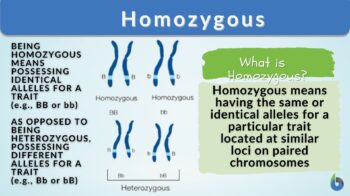
Definition: With the same or identical alleles for a particular trait located at similar loci on paired chromosomes
“
Table of Contents
Homozygous Definition
Diploid organisms that have a genotype of identical alleles for a trait or phenotype at a specific locus are described as homozygous. Such organisms could be either homozygous dominant or homozygous recessive. In such organisms, two traits can be expressed — either dominant or recessive.
- The literal meaning of homozygous = homo + zugos (Greek words, meaning “same”, “joined together”
Humans are diploid organisms and possess two sets of chromosomes wherein genetic material is inherited from both the parents, i.e., father and mother. All the genetic information is present in the form of genes in the DNA of the organism. Hence, in a diploid organism, for each trait, there are two sets of the gene (or two alleles) wherein each biological parent contributes one allele.
Accordingly, zygosity defines the degree of similarity between two genes or alleles at a locus, for a particular trait in an organism. Alleles are the variants of genes for a particular trait. Two or more variants of alleles can exist for a particular trait. An allele can be dominant or recessive. A dominant allele is expressed more while the recessive remains masked.
Consequently, zygosity can be: homozygous, heterozygous, hemizygous, or nullizygous.
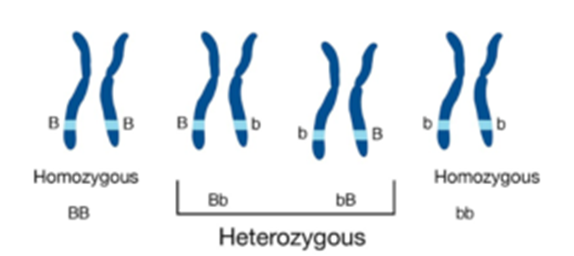
- Homozygous – Organisms that possess two similar sets of alleles at the same locus, for a particular trait, are defined as Homozygous organisms (Figure 1).
- Heterozygous – Organisms that possess two different sets of alleles at the same locus, for a particular trait, are defined as Heterozygous organisms (Figure 1).
- Hemizygous – Diploid organisms that possess only one allele for a trait at a specific locus are defined as Hemizygous organisms. In such organisms, there is only one allele or one gene is present for the trait, and the other allele is missing.
- Nullizygous – Diploid organisms devoid of both the alleles for a trait at a specific locus are defined as Nullizygous organisms. Thus, in Nullizygous organisms, both genes are missing for a trait. This results in loss of function.
Watch this vid about homozygous vs heterozygous :
Biology definition:
A homozygous refers to an individual (an organism, a gene, a genotype, or a condition) containing two copies of the same allele for a particular trait located at similar positions (loci) on paired chromosomes. The term homozygous is used to describe that which has the same or identical alleles for a particular trait located at similar loci on paired chromosomes (i.e. homologous chromosomes). In a diploid organism, there are two sets of chromosomes. One of the sets comes from the mother and the other set from the father. Each maternal chromosome has a corresponding paternal chromosome to match with based on their loci. When the loci in the matching chromosomes bear the same alleles, it is described as homozygous. It means that the alleles code for the same trait.
A ‘homozygous’ organism for a particular trait is described to possess either a pair of dominant alleles (e.g. AA) or a pair of recessive alleles (e.g. aa). True breeding organisms are homozygous since the trait in question can be held constant as they produce the same phenotypic result.
Etymology: Greek homo (“same”) + zygous (of a zygote).
Compare: Heterozygous
Related form: homozygosity (noun)
Homozygous Genotypes
As we know, the genetic material, i.e., the DNA of an organism carries all the information required for life processes. DNA has encoded information for all the protein synthesis that is required for all life processes. The encoded information for each trait is present in the genes which is referred to as genotype. The physical appearance of the trait is referred to as phenotype.
The crossing over of homologous chromosomes during sexual reproduction imparts variations in the genetic composition. The genetic variants of a gene (which may be due to genetic mutations or environmental variation) are known as alleles for a trait.
Some alleles are highly expressive and are known as dominant alleles while some remain masked as recessive alleles. Although in a homozygous organism, the interaction of the alleles remains unaffected as it can be either homozygous dominant or homozygous recessive.
In genetics, each trait can be either dominant or recessive. The dominant allele for a trait is represented by a capital letter while the recessive allele is represented by a small letter.
Homozygous dominant organisms carry both the dominant alleles of a trait, while the homozygous recessive organism carries two recessive alleles of a trait. Thus, homozygous recessive will have two recessive alleles at a locus and have a phenotypic expression of recessive traits. Let us understand this with a simple example using Punnett square.
Example 1: Homozygous father with black hairs has the dominant B allele while the homozygous mother with brown hairs has the recessive b allele. The progeny of such parents will have black hairs. Let us see it in Punnett Square (refer to Table 1).
Table 1: Punnett square of progeny from dominant black hair father (BB) and recessive brown hair mother (bb) |
||
|---|---|---|
| Father | ||
| Mother | B | B |
| b | Bb | Bb |
| b | Bb | Bb |
Data Source: Dr. Amita Joshi of Biology Online
As we can see all the offsprings in the progeny are of heterozygous genotype with the dominant phenotype of black hairs.
Example 2: Both the parents are heterozygous with black hairs as black hair is a dominant allele. The progeny of such parents could produce a homozygous offspring (Table 2).
Table 2: Punnett square of progeny from heterozygous genotype parents having black hairs (Bb) |
||
|---|---|---|
| Father | ||
| Mother | B | b |
| B | BB | Bb |
| b | Bb | bb |
Data Source: Dr. Amita Joshi of Biology Online
The progeny of heterozygous parents will have a higher probability of producing homozygous offspring. As we can see from the Punnett square in Table 2, two out of four progenies will be homozygous. BB represents the dominant homozygous genotype with two dominant alleles in the progeny with the phenotype of black hairs whereas bb represents the recessive alleles homozygous for the recessive trait or recessive phenotype of brown hairs. Two offspring will be heterozygous, Bb genotype and a phenotype of black hairs as the black allele is dominant.
Homozygous Vs Heterozygous
Table 3: Difference between Homozygous and Heterozygous |
|
|---|---|
| Homozygous | Heterozygous |
| Genetic constitution in a diploid organism wherein two identical alleles for a trait are present at the same locus | Genetic constitution in a diploid organism wherein different alleles are present at the same locus |
| Genotype representation, e.g., BB or bb | Genotype representation, e.g., Bb |
| Can be either homozygous dominant or heterozygous recessive | Can be complete dominance, incomplete dominance, and codominance |
| Two phenotypes can be expressed, either dominant or recessive | Only the dominant phenotype is seen; the dominant allele is phenotypically expressed while the recessive allele is masked |
| True breed | Crossbreed |
| Self-breeding in homozygous will result in the expression of the same trait/phenotype in all generations | Self-breeding in heterozygous will result in the expression of multiple traits/phenotypes in generations |
Data Source: Dr. Amita Joshi of Biology Online
Homozygous Dominant Examples
Inbreeding in animals and plants can result in either homozygous dominant or homozygous recessive. However, complete elucidation of the genetic constitution can reveal the presence of homozygous dominant traits in an organism.
Marfan syndrome and Huntington’s disease are two autosomal disorders that require the dominant allele. Although the person suffering from Marfan syndrome and Huntington’s disease could be heterozygous or homozygous dominant, which could be confirmed only by genetic mapping.
Homozygous Recessive Examples
Homozygous recessive traits can be relatively more easily elucidated as a recessive trait is expressed only when it is homozygous. For example, blue eye color is a recessive trait while brown eye color is a dominant color. Hence, a child born with blue eyes to brown-eyed parents represents a homozygous condition for the phenotypic expression of blue eye color in the offspring.
Sickle cell anemia, phenylketonuria, and cystic fibrosis are genetic diseases that occur due to recessive allele inheritance and is expressed in homozygous recessive condition only.
Inheritance of two alleles of cystic fibrosis transmembrane conductance regulator (CFTR) gene results in cystic fibrosis. While inheritance of mutated hemoglobin subunit beta (HBB) gene results in sickle cell anemia. Inheritance of two alleles of the mutated phenylalanine hydroxylase (PAH) gene results in Phenylketonuria.
NOTE IT!
Blood group ‘AB’ is purely a heterozygous trait (Genotype is IAIB) whereas blood group ‘O’ is a homozygous trait (Genotype is IoIo). This is due to the fact that alleles A and B are both codominant alleles while allele O is a recessive trait. Hence a homozygous condition leads to the expression of allele O.
Take the Homozygous – Biology Quiz!

References
- Collins, A., & Stewart, J. H. (1989). The knowledge structure of Mendelian genetics. The American Biology Teacher, 51(3), 143-149.
- Raal, F. J., & Santos, R. D. (2012). Homozygous familial hypercholesterolemia: current perspectives on diagnosis and treatment. Atherosclerosis, 223(2), 262-268.
- Zschocke, J., Byers, P. H., & Wilkie, A. O. (2022). Gregor Mendel and the concepts of dominance and recessiveness. Nature Reviews Genetics, 23(7), 387-388.
- Zschocke, J., Byers, P. H., & Wilkie, A. O. (2023). Mendelian inheritance revisited: dominance and recessiveness in medical genetics. Nature Reviews Genetics, 1-22.
©BiologyOnline.com. Content provided and moderated by Biology Online Editors.