Homologous structures definition
Table of Contents
Homologous Structures Definition
What are homologous structures? In biology, homologous structures are physical features found in different organisms that share a common ancestor. This similarity is due to shared ancestry between a pair of structures (i.e. homologous chromosomes) or genes in different taxa.
Homology is defined between structures or DNA derived from a common ancestor and illustrates the presence of common features or traits. A classic example of homologous structures is seen in the limbs of humans, cats, whales, and bats. Despite serving different purposes, these creatures have limbs that exhibit similar underlying structures, showcasing the concept of homology.
In biology and related fields such as anatomy and anthropology, these structures are exemplified by body parts that have the same anatomical composition or structural features.
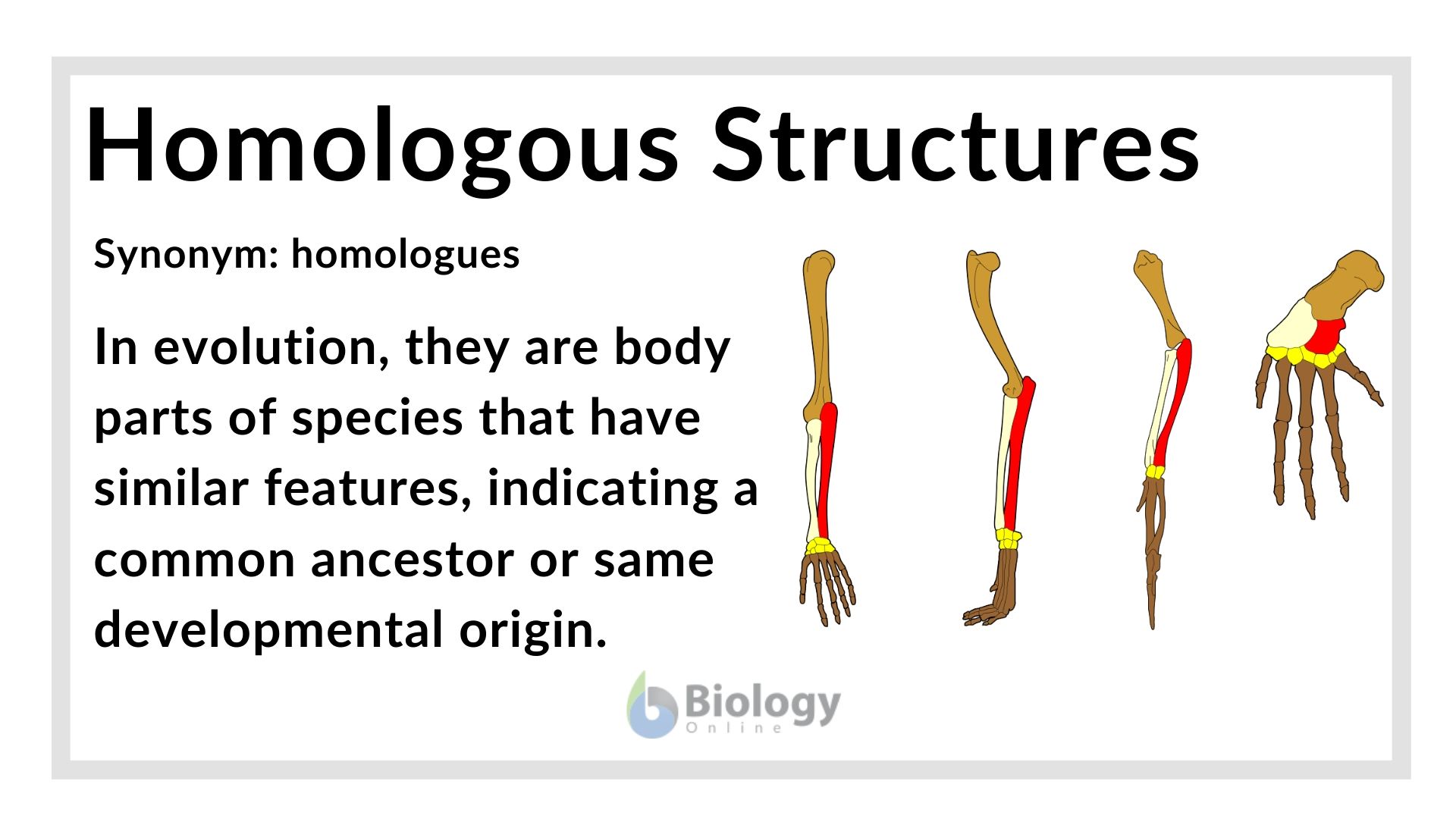
In evolutionary biology, organisms with such similarities could indicate a common ancestor or same developmental origin. The condition or state in which structures are homologous but they do not function the same way is referred to as “homology” (plural: homologies).
Synonym: homologues.
Compare: analogous structures.
Homologous Structures Examples
Limbs
Human upper limbs contain the same bone parts as those of the other animal upper limbs. Look at the figure below. The human arm is composed of the same set of bones, i.e. humerus, radius, and ulna, just as the arms of the other animals included in the figure.
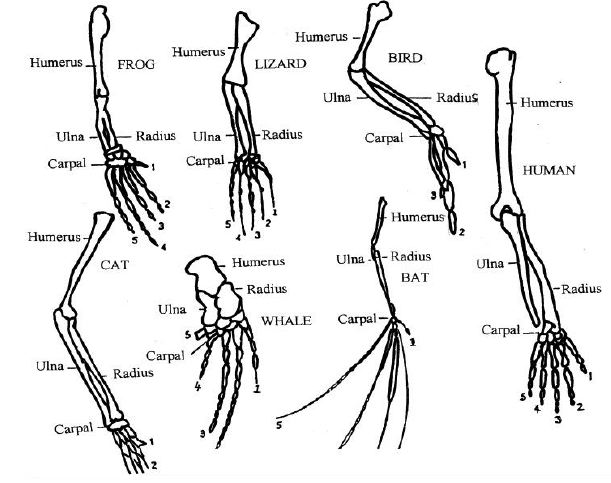
They are examples of homologous structures. Although their forelimbs are used differently, the basic skeletal structure is the same and they are derived from the same embryonic origin. This holds true as well to the lower limbs of animals when the basic bone components include femur, tibia, and fibula.
In this regard, animal limbs lacking bones like those of starfish and insects will, therefore, be not homologous to the limbs of the animals that contain bone structures as depicted above.
Vestigial structures
Vestigial structures are another example. They are remnants of the ancestral form. Over time, these structures could eventually lose or alter the original function. Nevertheless, they are essential as they could provide a clue or evidence as to the evolutionary history of a species. For example, the snake has remnants of a pelvis. This structure is homologous to the pelvises of humans, dogs, and cats. Humans have vestigial structures, too. The human tailbone palpable during the embryonic stage is a shred of evidence that humans and other tailed-mammals do share a common ancestor.
It should be pointed out though that one should not be too quick to think that all similarity is homology. Homologous structures are those from organisms that share a common ancestor. (Ref.1) The similarity in the anatomical features can be used to support conjectures regarding their evolutionary histories.
Homologous structures vs. analogous structures
Analogous structures are structures that have the same function; however, the organisms possessing them have dissimilar ancestral origins and represent unrelated evolutionary lines. Moreover, they do not live in the same location. In spite of that, they are able to evolve body parts or organs with similar function though separately. For example, the wings of bird, bat, and insect are analogous structures.
The contrasting wing anatomical features of these animals indicate that they are unrelated. The flippers of a whale and the fins of a fish are another homologous structures example. Although these structures are basically used for swimming their anatomical structures differ immensely.
The analogous structures may be dissimilar with regard to anatomy whereas the homologous structures may show similar anatomical features. In terms of development patterns, homologous structures show similar patterns whereas analogous structures do not.
Take the Quiz!

Related terms
See also
References
- Not all similarity is homology. (2020). Berkeley.Edu. https://evolution.berkeley.edu/evolibrary/article/0_0_0/similarity_hs_06
©BiologyOnline. Content provided and moderated by BiologyOnline Editors.