Gene
n., [dʒiːn]
Definition: The fundamental, physical, and functional unit of heredity
Table of Contents
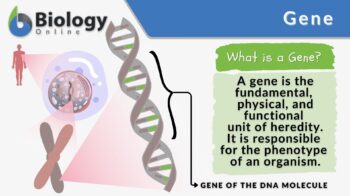
A gene is the fundamental, physical, and functional unit of heredity. The genes make up the sequences of DNA (genotypes). The genotypes, together with the other factors (e.g. environmental factors), determine the phenotypic trait of an organism. These changes in the genes drive evolution and natural selection.
The gene was formerly called a factor. The existence of a gene as an independent heritable factor was first identified by Gregor Mendel who is now credited as the father of genetics. Mendel formulated the laws of heredity based on his careful breeding experiments on garden pea plants. Later, it was called gene as introduced by Wilhelm Johannsen, a Danish botanist and plant physiologist, in 1905.
Prior to Mendel’s work, the popular belief is that male and female parents provide fluids that blend or mix during fertilization. Charles Darwin referred to the particles that mix at fertilization as gemmule. Mendel’s work was published in 1886. However, it was in the late 1900s that it was accepted as it was supported by the same results from the works of Hugo de Vries, Carl Correns, and Erich von Tschermak. (1)
Further study in the next century led to an understanding of the molecular structure and function of the gene. It was found that the gene is comprised of expressed DNA. The works of Rosalind Franklin and Maurice Wilkins and later on of James D. Watson and Francis Crick identified DNA structure. The scientific study of the patterns of inheritance of specific traits, relating to genes and genetic information and heredity is referred to as genetics.
Gene Definition
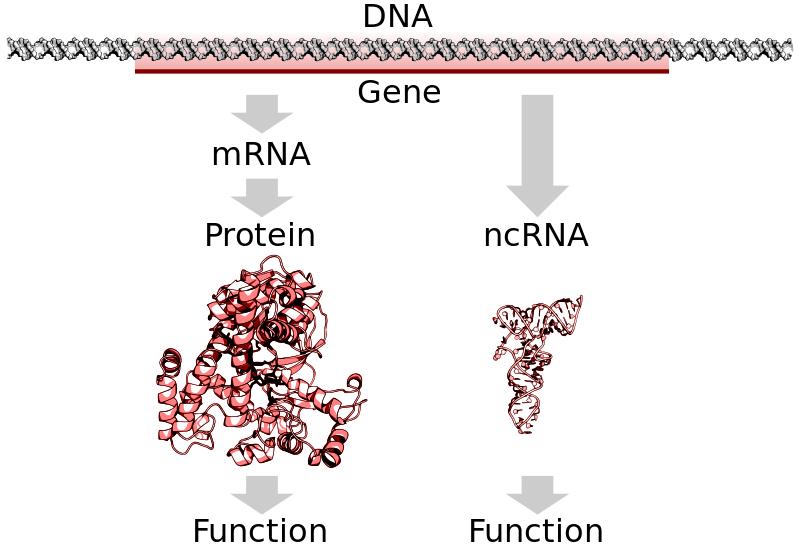
A gene is defined as the fundamental, physical, and functional unit of heredity since a gene is comprised of nucleotides (on a specific site on a chromosome) that is responsible for the physical and heritable characteristics or phenotype of an organism. It, therefore, specifies the structure of a protein, and an RNA molecule.
-
Etymology
The term gene came from the German gen, from gen, meaning “begetting” or from Greek genos, meaning “race”, “offspring”. Synonyms: factor (obsolete).
-
Gene vs. Genome
Genome is defined as the complete set of genetic material in an organism. Thus, all the genes contained inside a cell, i.e. the nuclear and extranuclear genes, are collectively referred to as the genome. For instance, the genome of a bacterium refers to the whole single chromosome contained inside it. The human genome, in contrast, is made up of approximately 35,000 genes or three billion chemical base pairs.
-
Gene vs. Allele
The variants of a gene controlling the same trait and occupying a specific region on a chromosome are referred to as alleles. A particular trait may be determined by a pair of alleles or by the interaction of a series of alleles as in the case of the multiple allelic traits (or polygenic inheritance). Certain traits are determined by a pair of alleles; one of them would be dominant while the other, recessive.
Gene Structure and Function
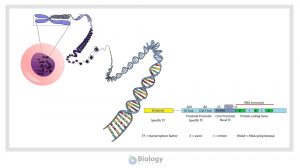
A gene is a sequence of nucleotides in a particular nucleic acid. Thus, it is a segment in DNA or RNA molecule that encodes for either an RNA or a protein by gene expression. The nucleotide is the structural unit of a nucleic acid. It is comprised of phosphoric acid, sugar (5-carbon), and a nitrogenous base. The chains of nucleotides in a nucleic acid are linked by 3′, 5′ phosphodiester linkages. This means that the 5′-phosphoric group of one nucleotide is esterified with the 3′-hydroxyl of the adjoining nucleotide.
Gene Expression
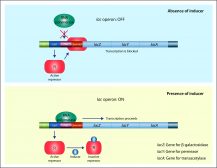
Gene expression entails the conversion of the information from the gene into mRNA (transcript) and then the transcript is translated into protein. Gene expression is therefore comprised of two major steps:
- Transcription
- Translation
In transcription, the gene coding for a particular protein is copied to mRNA through the help of the enzyme RNA polymerase. The process proceeds in the 5′ → 3′ direction via nitrogenous base pairing. In particular, guanine pairs with cytosine (and vice versa), thymine pairs with adenine, and adenine pairs with uracil (instead of thymine). In prokaryotes, transcription occurs in the cytoplasm whereas, in eukaryotes, it takes place primarily in the nucleus before the mRNA is transported into the cytoplasm for translation or for protein synthesis.
During translation, the resulting mRNA is decoded to produce a protein consisting of amino acids in a specific sequence. In both prokaryotes and eukaryotes, it takes place on the ribosomes. In eukaryotes, though, it occurs on the ribosomes that are attached to the surface of the endoplasmic reticulum (ER).
The translation is comprised of the following steps: initiation, translation elongation, and translation termination. Briefly, the ribosome binds to the mRNA, and then the tRNA attaches to the start codon of the transcript during the initiation phase. This is followed by translation elongation wherein a specific order of amino acids is brought to the ribosomal site by tRNAs based on the specified sequence of codons in mRNA.
The amino acids are joined in a chain by a peptide bond. Upon reaching the stop codon in the mRNA, the translation ceases and the newly formed protein matures, i.e. by protein folding or post-translation modifications. Gene expression results in the phenotypic manifestation of the gene.
Read: Genetic Control – On and Off Genes
Inheritance
Inheritance is the acquisition of traits from parents to offspring based on the transmitted genes that are expressed. Inheritance of a particular trait that follows Mendelian laws, such as the Law of Segregation, the Law of Independent Assortment, and the Law of Dominance, is a Mendelian type of inheritance. Conversely, an inheritance that does not follow Mendelian laws is a non-Mendelian type. Examples of non-Mendelian are codominance, incomplete dominance, and polygenic inheritance.
Read: Mendel’s Law & Mendelian Genetics & Non-Mendelian Inheritance
Mutation
The genes may acquire genetic changes. When they are permanent and heritable, these changes are called mutations. When genes mutate, variants (called alleles) are formed and this results in differences in phenotypic traits within a population. There are two major types of mutations: small-scale mutations and large-scale mutations.
Small-scale mutations involve one or a few mutated genes. Examples include deletions, substitutions, and insertions of one or more nucleotides. When several genes are involved, such as a region of a chromosome or sometimes the entire chromosome, the mutation is a large-scale type. Examples are deletion, inversion, or amplification of a chromosomal region or the entire chromosome. Large-scale mutations are often serious or lethal.
Read: Genetic Mutations – Biology Online Tutorial
Application
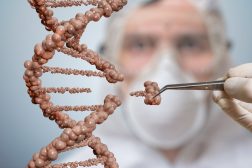
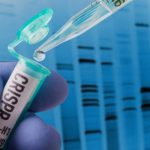
In medicine and the biomedical field, genes have been modified by biotechnology. The process is referred to, in particular, as genetic engineering. Scientists and researchers developed gene-editing techniques to modify genes or repair DNA. One of the most common applications is the addition of a gene into the genome of bacteria, enabling the latter to synthesize a target protein for use in medicine, industry, or agriculture. In multicellular organisms, editing or repairing of genes is done to treat genetic diseases. This is what gene therapy is about.
Read: Genetic Engineering Advantages & Disadvantages
NOTE IT!
Genetic Powers: Separating Science from Fiction
Superheroes have consistently dominated not just the cinema screens and various online streaming platforms but also championed humanity’s wishful dreams and adulation. From superhuman strength to death-defying supernatural maneuvers, one can only fancy owning such prowess beyond fiction.
We’ve seen tales of superhumans gaining superpowers attributed to their genes, especially through genetic mutations. Mutations are not confined to fiction though. They happen naturally. In fact, mutations are Nature’s shaping tools in forging biodiversity.
While some mutations can be detrimental, other mutations can be advantageous, bestowing new traits that help augment survivability and ensure the perpetuation of the species.
Thus, one might wonder:
Can humans eventually evolve and possess genes that will turn them into super human beings in the real world?
That depends on what we identify as “super”. As a matter of fact, we already have amongst us people gifted by Nature with extraordinary capabilities.
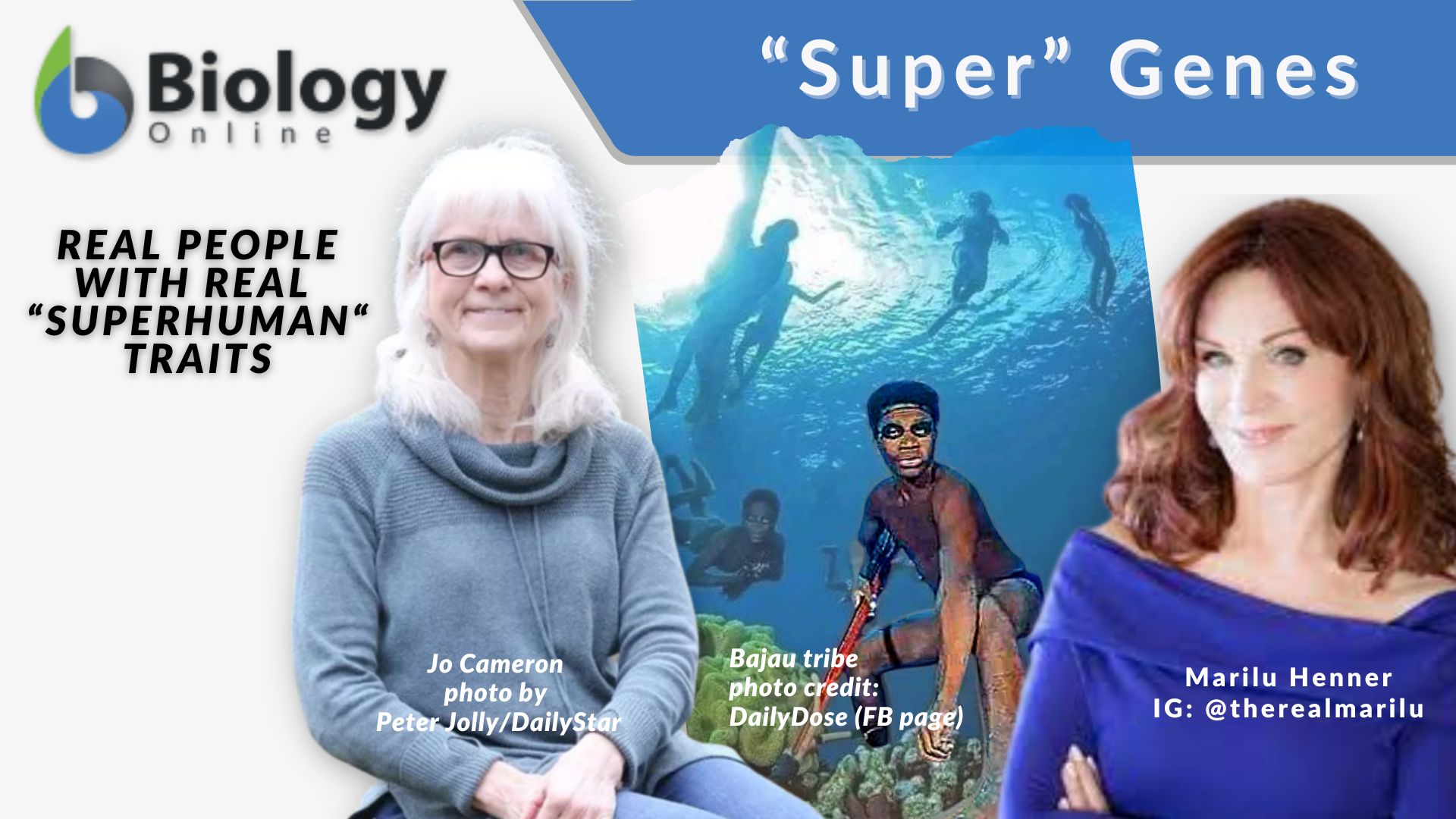
- Humans with superior memory skills: A super rare condition called highly superior autobiographical memory (HSAM) identified in only about a hundred people in the world is characterized by having the ability to recall events of their lives in almost photographic detail.
Case: Marilu Henner, the American actress - Humans who can resist pain: There are those who cannot feel pain over injuries that would be excruciating for most people.
Case: Jo Cameron, the Scottish woman who felt virtually no pain over her osteoarthritic hand and joint degenerative conditions. Turned out she had the FAAH-OUT mutation, which scientists later found to be associated with the lack of pain, reduced anxiety, and quick wound healing. - Humans who are extreme swimmers.
Case: Known as the Sea Nomads or the Sea Gypsies, the Bajau people can swim to the depths of the sea (around 200 feet) and stay underwater for as long as 13 minutes. Researchers found a DNA mutation in a gene called PDE10A that led them to have larger spleens, which meant having a larger reservoir of oxygenated red blood cells.
Can we alter human genes so that humans can possess supernatural powers and abilities? Though that idea is enticing and not far out as we already have in our hands genetic engineering techniques (such as CRISPR-Cas9 by which genes can be modified in a controlled way), its use remains restricted and highly regulated, e.g., in gene therapy. Beyond that, it will spark debates over ethical concerns and potential misuse.
Take the Gene – Biology Quiz!

References
- Henig, Robin Marantz (2000). The Monk in the Garden: The Lost and Found Genius of Gregor Mendel, the Father of Genetics. Boston: Houghton Mifflin. pp. 1–9.
- What are DNA and Genes? (2016). Retrieved from Utah.edu website: https://learn.genetics.utah.edu/content/basics/dna
- Rheinberger, H.-J., Müller-Wille, S., & Meunier, R. (2015). Gene (Stanford Encyclopedia of Philosophy). Retrieved from Stanford.edu website: https://plato.stanford.edu/entries/gene/
- Genetics Home Reference. (2019). What is a gene? Retrieved from Genetics Home Reference website: https://ghr.nlm.nih.gov/primer/basics/gene
- Gene Interactions. (2019). Retrieved from Estrellamountain.edu website: https://www2.estrellamountain.edu/faculty/farabee/biobk/BioBookgeninteract.html
© Biology Online. Content provided and moderated by Biology Online Editors.
CELL – LABEL THE PARTS (pdf) |
CELL – LABEL THE PARTS
This worksheet is useful in helping the students assess their familiarity with the different parts of the cell, both the eukaryotic and the prokaryotic types. This is useful in genetics as it helps gauge the student’s knowledge of the difference between the two cell types, especially in terms of the location of the genetic material. Subjects: Genetics & Evolution, Cell Biolgy |