Ganglia
n., singular: ganglion
[ˈɡæŋɡli.ə]
Mass of nerve tissue
Source: modified by Maria Victoria Gonzaga, from Ed Uthman, CC BY 2.0.
Table of Contents
Ganglia Definition
What are ganglia? To simply define ganglia in biology, it is the structure of an oval shape that contains the cell bodies of a neuron, glial, and connective tissue. Ganglia can also be defined as an encapsulated collection of bodies of nerve cells found on the outside of the brain and the spinal cord. These bodies make up the Peripheral Nervous System (PNS). They play the role of nerve signal relay stations. From each ganglion, one nerve enters (afferent), and the other nerve exits (efferent).
The cells, essentially found in ganglion are termed as ganglion cells and make up a system called the ganglion nervous system. They are sometimes referred to as peripheral ganglia, as they exist outside of the Central Nervous System (CNS).
Structure of Ganglia
The basic structure of ganglia primarily made up of somatic and dendritic parts that bundle up or connect. Ganglia that interconnect are termed as plexus.
In contrast to the PNS ganglion, the brain also has an interconnected nuclei network known as the “basal ganglia“, also called “basal nuclei“. The well-known locations of the basal ganglia the brainstem, thalamus, and cerebral cortex. These ganglia have many main functions, including motor control, feelings, intelligence, and learning.
Location of Ganglia
It is normally found outside of the spinal cord (spinal ganglion) and brain (cerebral ganglion). The spinal ganglion, for example, is found around the spinal cord’s dorsal region and around the spinal nerve where its ventral roots reside or where this cluster of nerves is located.
Ganglia vs. Nuclei
Differences
The major difference between the ganglia and the nuclei is their placement or location within the nervous system. Ganglia are clustered nerve cells located in the PNS while nuclei are those clustered nerve cells that are located in the CNS.
Axon pathways originating from ganglia are called the Peripheral Nervous System and those that originate from the nuclei are considered CNS tracts.
Most ganglion cells are sensory neurons that collect information from nerves. The nuclei, in turn, contain grey matter (where information is processed).
Similarities
- Ganglia and the nuclei are both a very important part of the nervous system and they are both involved in the process of signal transmission.
- Both the ganglia and the nuclei are having nerve clusters/nerve cell bodies.
- Ganglia and the nuclei both are originating points of bundles of nerve fibers.
Functions of Ganglia
Ganglia act as relay stations, allowing nerves to enter and leave simultaneously all the time. They are at work non-stop, keeping the living body functioning, like many other cells of the body.
Ganglia control the functioning of the organs and glands of the body as a part of the autonomic nervous system.
Based on their types, the tasks of ganglia are divided. Their names define their primary functions. For instance, sensory ganglia are involved in sensing the stimuli whereas autonomic ganglia are involved in controlling autonomic functions.
Difference Between a Nerve and a Ganglion
A nerve can be confused with a ganglion. So, it is important to take note of the difference between them to avoid such confusion. Both nerves and ganglia are structures found in the nervous system. However, a ganglion refers to a collection of nerve cells outside of the CNS whereas a nerve is the axon of a neuron. An afferent neuron, by the way, carries impulses whereas an efferent neuron is involved in motor functions.
Types of Ganglia
There are three major classes of ganglia in vertebrates:
- Dorsal Root Ganglia (DRG) or sensory ganglia (also termed spinal ganglia) – contains cell bodies of the sensory neurons
- Cranial nerve ganglia – ganglia consisting of the cell bodies of cranial nerve cells
- Autonomic nerves – ganglia consisting of the cell bodies of autonomic ganglia
Dorsal root ganglia (DRG)
The dorsal root ganglia carry sensory neural signals from the PNS to the CNS. The neurons of dorsal root ganglia arise from the dorsal root of the spinal nerves, carrying sensory signals to the CNS for a response from multiple receptors, including for pain and temperature.
Pseudo-unipolar neurons are considered to be dorsal root ganglia neurons, with one axon dividing into two different branches, resulting in a distal and proximal process. Action potentials generated by peripheral impulses do not always have to pass through the dorsal root ganglia; they can also escape the dorsal root ganglia and pass through the proximal process and the spinal cord.
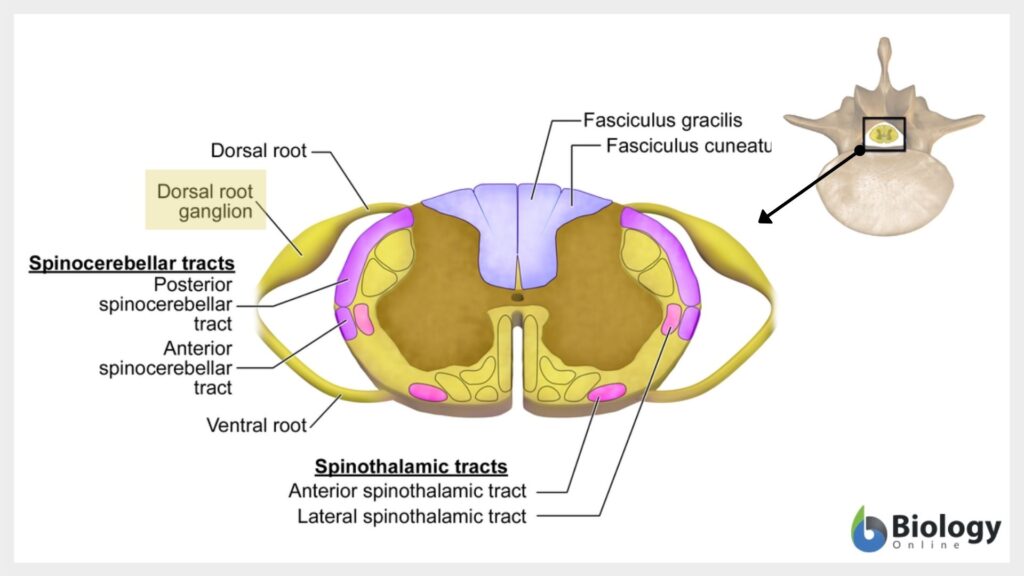
These ganglia consist of a neuron network and glial cells that transmit sensory information (temperature, cognition, sensation, pressure, etc.) from PNS to CNS.
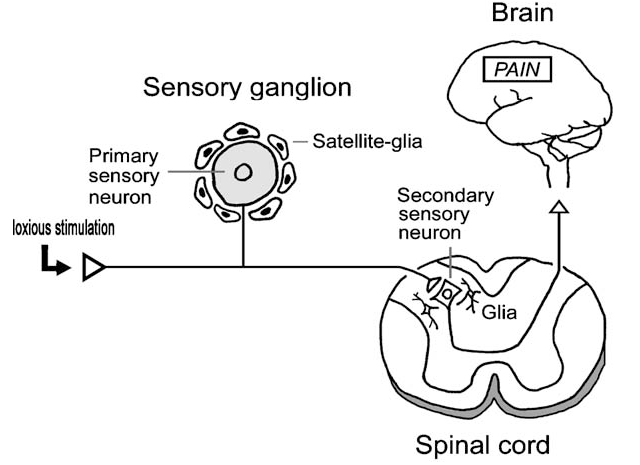
This type of ganglion is generally unipolar or pseudounipolar with a central nucleus. Each unipolar cell is covered by two cell layers, the inner layer is made up of satellite cells, which are flat cells with small oval nuclei, and the outer layer of connective tissue capsule cells. There are also several fibrocytes in the surrounding connective tissue. Another important aspect of the sensory ganglia is that they do not have any synapses.
Dorsal root ganglia consist of a cell body of sensory neurons (thus, also referred to as sensory ganglia). There are bundles of sensory nerves located at the base of the spine that can respond to mechanical, chemical, and thermal stimuli.
Based on the location, the ganglia may be spinal ganglia or cranial nerve (CG) ganglia. Spinal ganglia can be found in the lumbar, thoracic, and cervical regions at their dorsal roots. They can also be found around the origin of the spinal cord in sacral spinal nerves. The cranial nerve is situated at the bases of the following cranial nerves where they reach the brain stem:
- V (trigeminal)
- VII (facial)
- IX (glossopharyngeal)
- X (vagus)
The sensory ganglia are responsible for motor and sensory input primarily to the head and neck regions. The sensory input involves both “common” stimuli, such as touch and temperature, in addition to the “special” stimuli, such as smell, vision, taste, hearing, and balance. The X nerve (vagus) supplies parasympathetic or autonomous and sensory inputs to the muscles in a body, as well as to most of the chest and abdominal organs. It also provides information that leads to a heightened sense of smell.
Cranial nerve ganglia
The cell bodies of neurons of the cranial nerve constitute the cranial nerve ganglia. It is connected with the cranial nerve (linked with the brain) rather than the spinal nerve (linked with the spinal cord). These cranial nerves have their roots inside the cranium, while the ganglia are outside the skull. With associated satellite cells, the sensory neurons of the cranial nerve ganglia are unipolar in shape.
The cranial nerve ganglia comprise of subtypes i.e. the sensory ganglia and the parasympathetic ganglia. The sensory ganglia subtype of these cranial nerves is also known as cranial nerve ganglia. They refer directly to the DRG of the spinal nerves. There are also some parasympathetic cranial nerve ganglia. In the upper sympathetic trunk, the sympathetic ganglia reside. They connect to the head and neck and do not relate to the cranial nerves.
Cranial nerves help in providing motor and sensory input primarily to the head and neck structures. This sensory input contains “general” sensations such as touch and temperature, as well as the “special” sensations such as smell, vision, taste, hearing, and balance. The vagus nerve is responsible for providing sensory and autonomic input to the structures in the neck and the majority of the chest and abdominal organs.
Autonomic ganglia
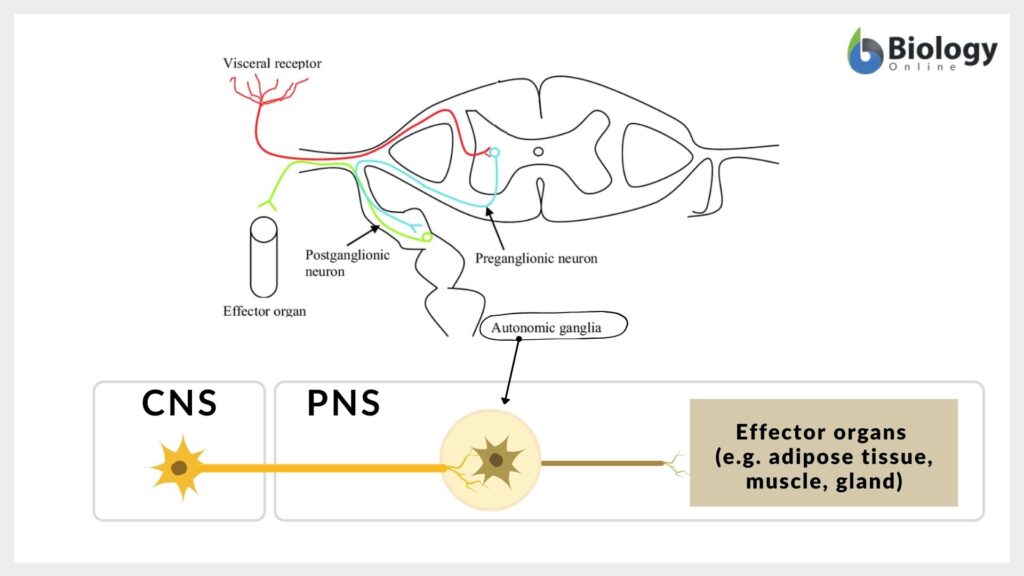
The clustered neuronal cell bodies along with their dendrites constitute the autonomic ganglia. They can be described as junctions between the autonomic nerves of the CNS and the autonomic nerves that innervate their targeted peripheral organs. In other words, the clusters of neuronal cell bodies that transmit peripheral sensory signals to the CNS integration centers are termed the autonomic ganglia.
The ganglia are covered by dense connective tissue capsules. The cell bodies of postsynaptic neurons that conduct impulses to the glands, smooth, and cardiac muscles involve autonomic ganglia.
The nerve fibers that pass from the CNS to the ganglia have the name of preganglionic fibers. The nerve fibers coming from the ganglia bound to the organs of the effector are called postganglionic fibers.
Autonomic ganglia are further classified into two types which are sympathetic and parasympathetic.
Sympathetic ganglia
As the name implies, the ganglia that comprise the sympathetic nervous system can be called a sympathetic ganglion. They provide the body with information about tension and serious threats. They are involved in the common fight-or-flight response. Almost around 20,000 – 30,000 nerve cell bodies, both afferent and efferent, constitute the sympathetic ganglia, existing in the form of long close chains along the margins of the spinal cord.
Based on their location within the body, the sympathetic ganglia can further be branched into two main classes: the prevertebral ganglia and the paravertebral ganglia.
Prevertebral ganglia. Prevertebral ganglia are midline structures found at the front of the aorta and vertebral columns. They are the structures that separate the target organ and the paravertebral ganglia. The preganglionic nerves synapsing in the nodules i.e. these ganglia with postganglionic counterparts have their nerve connections in the pelvic viscera. The target areas of these ganglia can be found in the pelvic viscera where they innervate the organs.
Three prevertebral ganglia are the inferior or lower mesenteric, superior or upper mesenteric, and celiac ganglia (including the aortic renal ganglion).
- The lower mesenteric ganglion has nerves grown in the urinary bladder, rectum, sigmoid colon, descending colon, and reproductive organs.
- The upper mesenteric ganglion grows nerves into the small intestine.
- The celiac ganglion has nervous connections in most part of the digestive tract, going at the beginning of the small intestine, duodenum, stomach, liver, and pancreas.
Paravertebral ganglia. The paravertebral ganglia or sympathetic chain ganglia, run next to the sympathetic trunks. They are present near the vertebrae and the spinal nerves laterally. These ganglia chains exist as pairs and are present only laterally to the vertebral bodies. The chain runs along the vertebrae all the way from the upper neck extending towards the coccyx, where the chain forms an unpaired coccygeal ganglion.
In general, these paravertebral ganglia can be found lying on either side of the vertebrae, forming a link to the sympathetic trunk. These ganglia generally consist of twenty-one or twenty-two pairs. Among these pairs, three are present in the cervical region, four are found in the lumbar, four are located in the sacral region, ten or eleven are occupying the thoracic region, while a single unpaired ganglion is encountering a coccyx.
All paravertebral ganglia have a sympathetic nerve connection grown into the blood vessels that are present in the body’s muscles, into the arrector pili muscles that are attached to the hair, as well as the sweat glands.
Functions of sympathetic ganglia
The sympathetic chain ganglia function to stimulate numerous and a variety of pathways and components to initiate the fight-or-flight response. In this response, they enable pupil dilation, higher blood pressure, faster heart rate, quicker breathing, and the changes in blood flow that allow the blood to leave the areas of the intestine, stomach, and skin, and continues to the muscles, heart, and brain, where it is required. The rising of the hair on the skin on end, increased sweating, and “goose-bumps” is experienced which is also due to the sympathetic chain ganglia.
The following are the things that an individual commonly experiences during a fight-or-flight response.
- Increase in saliva that is rich in mucus (salivation)
- Elevated heart rate and increased stroke volume
- Dilator effects on the blood vessels
- Enhanced Catecholamine secretion
- Fat breakdown rate increased
- Ejaculation elevated
- Increase in pupil dilation
Sympathetic ganglia transmit any and all stress and/or immediate danger information to the body. They are also in control of a very common response called the ‘fight-or-flight’ response. Through behavior such as sweating for heat loss, dilation of vessels to allow more blood flow to the organs, increased breakdown of fats for energy, or by changing cardiac output based on the position and activity level, the sympathetic ganglia can maintain homeostasis. It is an essential requirement for any living being to achieve and/or maintain homeostasis for survival and because of such primary need, every system of their body is mainly striving to achieve and/or to maintain homeostasis. Similarly, despite the division of labor in cells in the human body, the sympathetic ganglia and other cells aim for the same goal.
Parasympathetic ganglia
In the PNS, the autonomic ganglia present are called the parasympathetic ganglia. These parasympathetic ganglia are involuntary and function with a sympathetic system to maintain, among other functions, body homeostasis. Homeostasis refers to the maintenance of the internal environment irrespective of the external changes in the world. It is a crucial element in all living beings that allows them to survive. Parasympathetic ganglia, like other elements of the body, constantly strive to ensure that the body’s homeostasis is maintained. For this purpose, it controls the involuntary actions that the body is doing while it rests such as energy conservation by reducing the heart rate, constricting the vessels to reduce the unnecessarily increased volume being pumped to the body parts, secretion by the lacrimal glands to keep the eyes moist and protected, and many others.
The ‘rest and digest’ response is associated with the most significant actions that the parasympathetic nervous system is responsible for. As implied by the name, it allows the relaxation of the body, the body rests, or it feeds. In other words, it is the undoing of the work of sympathetic ganglia such as the reduction in the heart rate, decreased respiration, and increased digestion. In the Central Nervous System, presynaptic parasympathetic neuron cell bodies are found at two sites and their fibers are exiting by two routes.
The fibers exit the CNS through four cranial nerves which are oculomotor (III), facial (VI), glossopharyngeal (IX), and vagus (X) in the grey matter of the brainstem, constituting the cranial parasympathetic outflow. The exit of fibers from the central nervous system is through the ventral roots of the spinal nerves in the grey matter of the bottom segment of the spinal cord also known as the sacrum.
The parasympathetic system is considerably more limited in its distribution than the sympathetic system. The parasympathetic system is only distributed to the head, visceral cavities of the trunk, and erectile external genital tissue.
Functions
- Constricts the pupil (protects the pupil from extremely bright light).
- Contracts the ciliary muscle to thicken the lens for close vision.
- The secretion of the lacrimal glands is stimulated for lubrication and moistening of the eyes.
- Enhances frequent watery secretions of the salivary glands.
- Reduces contraction rate and strength (energy conservation); constricts the coronary vessels in the context of reduced demand.
- Constricts bronchi (energy conservation) and facilitates the secretion of bronchi of the lungs.
- Peristalsis and secretion of digestive juices are stimulated.
- Contracts rectum and prevents the internal anal sphincter that allows defecation.
- Promotes glycogen building/conservation and increases bile secretion.
- Inhibits the urinary bladder internal sphincter contraction, and contracts the urinary bladder wall muscle which causes urination.
Terminal ganglion
A terminal ganglion is a commonly parasympathetic ganglion situated on or around an innervated organ and is the site where preganglionic nerve fibers terminate. The terms commonly used for most of them are small terminal ganglia as well as the intramural ganglia. The names come from their positioning in the body since they can be found close to or inside the organs which their nerve connections grow into respectively.
Sensory ganglia vs. Autonomic ganglia
Sensory ganglia
- Sensory ganglia innervate the voluntary skeletal muscles of the body.
- The sensory stimuli that the somatic ganglia detect are smell, sound, taste, light, touch, pain, and temperature.
- The effector organ is separated from the central nervous system by a single neuron between them in the sensory ganglia.
- It is always caused by an excitatory response to the effector.
- It is composed of dense myelinated nerve fibers.
Autonomic ganglia
- Autonomic ganglia innervate involuntary smooth muscles, heart muscles, and glands.
- The sensory stimuli that the autonomic ganglia detect are blood pressure, salinity, and pH.
- The central nervous system is connected with the effector organ via two neurons with a single synapse between them in the autonomic ganglia.
- It may cause an excitatory or inhibitory response to the effector.
- It is composed of both thick and thin myelinated nerve fibers.
Dysfunction of the Ganglia
Harm to the cells of the basal ganglia can cause speech, motion, and posture control problems. This occurrence of symptoms is known as Parkinsonism. A person with basal ganglia disorder may have trouble starting, stopping, or controlling movement. Based on which region of the brain is impaired, there may also be memory disorders and other thought processes issues.
The below symptoms are present during the dysfunction of ganglia. The symptoms usually vary and can include:
- Changes in movement, such as involuntary or sluggish movements
- Increase in the muscular strength
- Muscle pain, headaches, and muscle stiffness
- Troubles finding words
- Tremor
- Abnormal repetitive movements
- Difficulty in walking
Many brain diseases are associated with basal ganglion dysfunction. They include, but are not limited to, the following:
- Dystonia (problems with the muscular tone – uncontrollable contraction of muscles)
- Huntington’s disease (a disease in which nerve cells in the specific parts of the brain waste away or degenerate)
- Multiple organ atrophy (widespread disease related to the nervous system)
- Parkinson’s disease (a progressive problem in parts of brain leading to impaired movement)
- Progressive supranuclear palsy (a disorder of action from brain injury to some nerve cells)
- Wilson disease (a disorder that causes too much copper in the body’s tissues)
Try to answer the quiz below to check what you have learned so far about ganglia.

References
- 14.2B: Autonomic Ganglia. (2020). Retrieved 8 October 2020, from https://med.libretexts.org/Bookshelves/Anatomy_and_Physiology/Book%3A_Anatomy_and_Physiology_(Boundless)/14%3A_Autonomic_Nervous_System/14.2%3A_Structure_of_the_Autonomic_Nervous_System/14.2B%3A_Autonomic_Ganglia#:~:text=Autonomic%20ganglia%20are%20clusters%20of%20neuronal%20cell%20bodies%20and%20their,target%20organs%20in%20the%20periphery.
- Chapter 11. (2020). Retrieved 8 October 2020, from http://droualb.faculty.mjc.edu/Course%20Materials/Physiology%20101/Chapter%20Notes/Fall%202011/chapter_11%20Fall%202011.htm
- Fagg, W. (2020). Chapter 16. Retrieved 8 October 2020, from https://www.slideserve.com/wes/the-autonomic-nervous-system-sympathetic-thoraco-lumbar-division-parasympathetic-cranial-sacral-division
- Structure of the Autonomic Nervous System | Boundless Anatomy and Physiology. (2020). Retrieved 8 October 2020, from https://courses.lumenlearning.com/boundless-ap/chapter/structure-of-the-autonomic-nervous-system/
- BALENTINE, J. (2004). Cecil Textbook of Medicine, 22nd EditionBy Lee Goldman and Dennis Ausiello. Philadelphia, PA: Saunders (an imprint of Elsevier), 2004, 2,496 pages. Academic Emergency Medicine, 11(9), 997.
- Barker, R., Cicchetti, F., Neal, M., & Barker, R. (2012). Neuroanatomy and neuroscience at a glance. John Wiley & Sons.
- Castro, M. (2020). Difference Between Somatic and Autonomic Nervous System | Difference Between. Differencebetween.net. Retrieved 8 October 2020, from http://www.differencebetween.net/science/health/difference-between-somatic-and-autonomic-nervous-system/.
- Chase, R. (2000). Structure and function in the cerebral ganglion. Microscopy Research and Technique, 49(6), 511-520.
- Hallett, M. (1993). Physiology of Basal Ganglia Disorders: An Overview. Canadian Journal of Neurological Sciences / Journal Canadien Des Sciences Neurologiques, 20(3), 177-183.
- Jankovic, J. (2017). Progress in Parkinson disease and other movement disorders. Nature Reviews Neurology, 13(2), 76-78.
- McMinn, R., & Last, R. (2009). Last’s anatomy. Churchill Livingstone.
- Ozawa, K., Atsuta, Y., & Kato, T. (2001). Chronic Effects of the Nucleus Pulposus Applied to Nerve Roots on Ectopic Firing and Conduction Velocity. Spine, 26(24), 2661-2665.
- Rauk, R. (1996). Umphred DA, ed Neurological Rehabilitation, 3rd ed. St Louis, Mo. Neurology Report, 20(1), 64.
- Sherwood, L., & Sherwood, L. (2012). Fundamentals of human physiology. Brooks/Cole, Cengage Learning.
©BiologyOnline. Content provided and moderated by BiologyOnline Editors.