Facultative anaerobe
n., plural: facultative anaerobes
[ˈfæ.kəlˌteɪ.tɪv ˈænəˌɹoʊb]
Definition: anaerobes that discretionary respire, i.e. anaerobically or aerobically
Table of Contents
Facultative Anaerobe Definition
What does facultative anaerobe mean? Facultative organisms are the most adaptable organisms that can survive in the presence, as well in the absence, of molecular oxygen. These organisms (generally Bacteria or Archaea or certain eukaryotes) generate adenosine triphosphate (ATP) through aerobic respiration when present in the oxygen-enriched environment, however, in an oxygen-deficient environment, these organisms have the capability to derive energy for survival from anaerobic respiration or fermentation process.
So, can facultative anaerobes survive with or without oxygen? It can be said, Yes! These organisms can survive with or without oxygen as these organisms have the capability to switch between an aerobic or anaerobic respiratory mode for the generation of energy.
A facultative anaerobe is an organism that is capable of producing energy through aerobic respiration and then switching back to anaerobic respiration depending on the amounts of oxygen and fermentable material in the environment. Etymology: an- from Gk., “not, without,” + Greek āero-, from āēr, air. Compare: obligate anaerobe, microaerophile, aerotolerant.
Facultative anaerobe organisms have evolved to adapt to extreme environmental conditions wherein they have adapted to utilize alternative electron acceptors in the electron transport chain, which is the basic chemical reaction involved in the generation of ATP during cellular respiration, as well as photosynthesis. Facultative anaerobe can utilize nitrate, nitrite, fumarate, elemental sulfur, or metal ions like iron or manganese as an electron acceptor when placed in an oxygen-deficient environment. As facultative organisms have the capacity to survive in oxygenated as well deoxygenated environments, the question is: which condition is preferable for their survival, aerobic or anaerobic? Do facultative anaerobes grow better in oxygen or in the absence of oxygen?
Well, facultative anaerobes may grow better in aerobic conditions based on the ATP yield. This is because aerobic respiration yields 36/38 ATP molecules as against 2 ATP molecules generated in fermentation.
To understand the transition of facultative anaerobes to aerobic respiration or vice versa, we need to have a basic understanding of the bioenergetic cycle involved in respiration, i.e., the electron transport chain. The generation of proton motive force (pmf) across the membrane due to the reduction of the electron acceptor substrate in the final step of the electron transport chain serves as the primary point for the generation of the ATP. Eventually, pmf is involved in the ATP generation. In facultative anaerobes, the pmf generation takes place by a number of alternative pathways, as discussed below.
- Nitrate Respiration: Here, in place of oxygen, nitrate is utilized as an energetically favorable electron acceptor in the electron transport chain. Nitrate is reduced to nitrite that is eventually converted to molecular Nitrogen, N2, (i.e. NO and N2O) via denitrification process. Or, it may be converted to ammonium by a process known as respiratory nitrite ammonification.
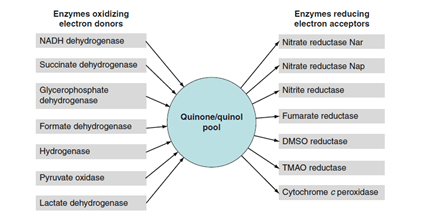
- Fumarate Respiration: In this mode of respiration, quinol oxidation results in fumarate reduction, which eventually yields succinate. Quinone-dependent oxidation of the formate results in the generation of pmf and is most commonly observed in the facultative anaerobe, E.coli. The figure below illustrates the electron transport chain in E.coli.
- Sulfur Respiration: Here, elemental sulfur that is present in the form of polysulfide is reduced by the membrane-bound polysulfide reductase. Desulfuromonas acetoxidans and W. succinogenes are the two bacteria that thrive upon sulfur respiration.
- Electron Transport to Oxidized Metal Ions: Geobacter and Shewanella species utilize oxidized metal ions like Fe3+ and Mn 4+, as electron acceptors in the electron transport chain. Fe 3+ used in the electron transport chain results in the formation of magnetite (Fe3O4), a ferromagnetic mineral.
Now, it is important to understand: What enzymes do facultative anaerobes have?
Facultative anaerobes are rich in enzymes superoxide dismutase (SOD) and/or catalase. Enzyme SOD eliminates the harmful superoxide anion by converting it into ground-state oxygen along with hydrogen peroxide. Thus eliminating or neutralizing destructive superoxide anions from the cell via the following chemical reaction.
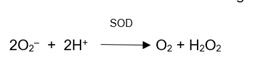
The reaction product is hydrogen peroxide, which is an oxidizing agent. It has a tendency to diffuse out of the cell. However, many facultative anaerobes also have catalase enzymes, which further help to eliminate the hydrogen peroxide from the cell as well. Catalase utilizes hydrogen peroxide as an oxidant (electron acceptor) as well as a reducing agent (electron donor) resulting in the formation of water and molecular oxygen.

The most common examples of the facultative anaerobes are bacteria (e.g., Escherichia coli, Pseudomonas aeruginosa, Staphylococcus spp., Listeria spp., Salmonella, Shewanella oneidensis, and Yersinia pestis), Archaea, certain eukaryotes (e.g., Saccharomyces cerevisiae) and invertebrates, like nereid and polychaetes. Many of the human pathogenic bacteria are facultative anaerobes, like Salmonella and P. aeruginosa.
Temperature, pH, and oxygen have always been the core environmental condition that has led to the evolution of life on earth. Depending on these physical environmental conditions, organisms, especially prokaryotes, have been classified into various categories. In the current context, we will limit our classification based on the availability of oxygen.
Types of Organisms: based on energy requirement
Based on the critical need for environmental oxygen, organisms can be classified into the following categories:
Obligate aerobe
These organisms mandatorily need molecular oxygen (O2) for their survival and growth. These organisms derive energy by aerobic respiration wherein they utilize O2 as a final electron acceptor. Examples are Mycobacterium tuberculosis, Nocardia asteroids, etc. Based on the tolerance to the amount of oxygen, Obligate anaerobes can be categorized as:
- Strict: Those which can endure only ≤ 0.5% oxygen
- Moderate: Those who can endure 2 to 8% oxygen
- Aerotolerant obligate anaerobes: Those which can endure atmospheric molecular oxygen only for a limited duration
Obligate anaerobes (occasionally called aerophones)
These organisms completely don’t need or utilize O2. In effect, for such organisms, O2 is toxic, which can result in complete inhibition or killing of these organisms. These organisms derive their complete energy from fermentation or anaerobic respiration or bacterial photosynthesis, or methanogenesis. Actinomyces, Bacteroides, Clostridium, etc are some of the anaerobic bacteria.
Facultative anaerobes
So, what is a facultative anaerobe?
Facultative anaerobe definition biology- The organisms which can survive in both oxygenated as well as the deoxygenated environment are known as facultative anaerobes. These are the most adaptable organisms that have the capability to switch between aerobic and anaerobic types of respiration. In anaerobic conditions (i.e., O2 deficient environment) these organisms survive and grow by either fermentation or anaerobic respiration, while, in the oxygenated environment these organisms switch to aerobic respiration. Escherichia coli, Pseudomonas aeruginosa, Staphylococcus spp., Listeria spp., Salmonella are some of the facultative bacteria.
Aerotolerant anaerobes
These are the bacteria that survive entirely on an anaerobic (fermentative) type of metabolism however, the presence of O2 does not affect these organisms. Thus, it can be said that these organisms are insensitive or tolerant to the presence of O2. Such organisms completely derive energy from fermentation alone irrespective of the presence of environmental O2. Examples are- Campylobacter jejuni, lactobacilli, and streptococci.
Microaerophile
Those organisms that need a low amount of O2 for their survival i.e., a lower concentration of oxygen than is present in the atmosphere (below 21%). These are different from aerotolerant organisms as these organisms need oxygen for their survival, however in extremely low amounts. The environment with 8-10% carbon dioxide and 5-10% oxygen is considered to be microaerophilic. Some of the common examples are Actinomyces, Clostridium, Propionibacterium, Bifidobacterium, Bacteroides, Fusobacterium, Prevotella, etc.
Thioglycolate Tube Culture Identification Test
This is a simple test that can help to identify different kinds of bacteria, depending on their oxygen requirement. The difference in the behavior of different organisms in oxygenated and deoxygenated environment can be observed in vitro in the test tube by growing bacteria in thioglycolate culture media.
The sterilized thioglycolate medium permits complete motility of the test bacterium as it contains a low amount of agar. Sterilizing thioglycolate medium, which has strong reducing properties, removes oxygen from it. Thus, at the time of inoculation of the bacteria in the culture tubes, the media is completely devoid of oxygen. Post-inoculation, the culture tubes are maintained at optimum temperature for bacterial culture to grow.
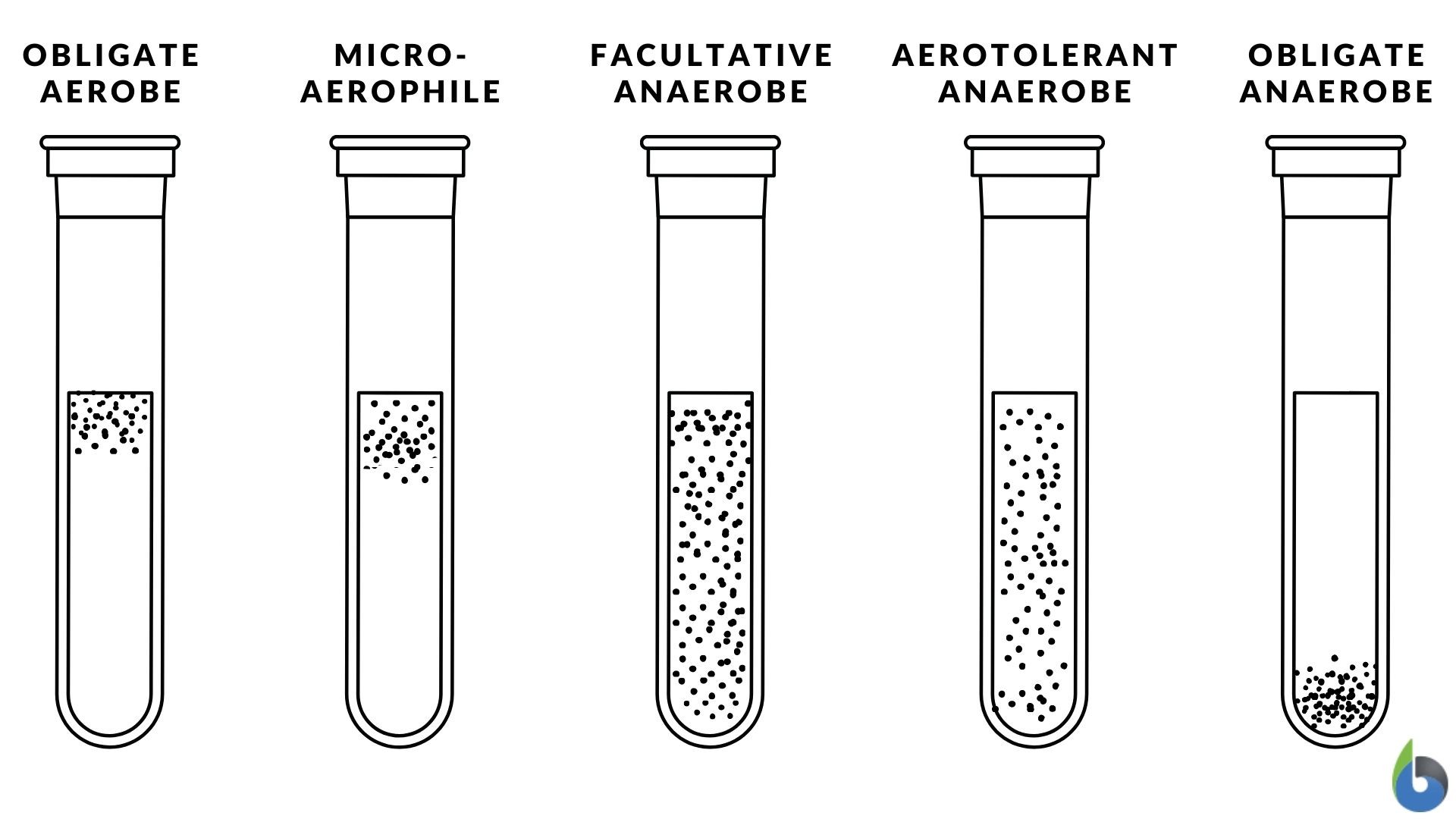
Over a period of time, thioglycolate media acquires oxygen by diffusion. The topmost area of the culture is rich in oxygen while the bottom part of the culture tube is devoid of oxygen. Depending on the nature of the bacteria (i.e., Obligate aerobes, Obligate anaerobes, Facultative anaerobes, Aerotolerant anaerobes, Microaerophile), the organisms will occupy their most desirable place in the culture tube. This is illustrated in Fig 1. Thus, obligate (strict) aerobes occupy the position at the top of the culture tube, which is most oxygenated. Conversely, obligate anaerobes have a maximum density at the bottom of the culture tube, which is the place in the culture tube that is deoxygenated and hence supports the survival of the obligate anaerobes only. On the other hand, facultative anaerobes, due to their ability to survive in oxygenated as well as the deoxygenated environment are uniformly distributed throughout the culture tube.
Since the growth of such an organism is more favorable in aerobic conditions, a relatively higher density can be seen at the mouth of the culture media. Nevertheless, these bacteria can thrive in oxygenated as well as deoxygenated conditions. Similarly, an aerotolerant bacterial culture is also distributed throughout the culture media as they are not affected by the presence of oxygen and are completely tolerant to the presence of environmental oxygen. Hence, they can survive easily throughout the media.
Microaerophiles, on the other hand, need a small amount of oxygen for their survival and hence, their density would be higher in the area of the test tube wherein oxygen is present, although in a very small amount, as shown in Figure 2.
Prokaryotes: Facultative Anaerobes vs Obligate Anaerobes
From the above discussion, it is clear that there are two major groups of anaerobic organisms: (1) obligate anaerobes and (2) facultative anaerobes. Hence, it becomes pertinent to have a clear understanding of these two types of anaerobes. See table below.
Table 1: Comparisons between Obligate Anaerobes and Facultative Anaerobes |
|
|---|---|
| Obligate Anaerobes | Facultative Anaerobes |
| As the name ‘Obligate’ suggests, these organisms need a completely anaerobic environment i.e., an environment devoid of oxygen, for their survival. [The word obligate means, necessarily or strictly] | These organisms are highly adaptable and can survive in the presence, as well as the absence, of oxygen by switching their metabolic process from aerobic to an anaerobic mode or vice versa. |
| These organisms can not survive in presence of molecular oxygen i.e., oxygen is poisonous to these organisms | These organisms can survive in either presence as well as the absence of molecular oxygen and oxygen does not kill these organisms. |
| These organisms exhibit either fermentation or anaerobic respiration | These organisms exhibit aerobic, anaerobic, or fermentation for respiration |
| In a culture tube, these organisms accumulate at the bottom of the test tube | In a culture tube, these organisms are uniformly distributed throughout the test tube |
| Enzyme superoxide dismutase is either present in negligible amount or, completely absent | Facultative anaerobes are rich in enzyme superoxide dismutase |
| Examples: Actinomyces, Bacteroides, Clostridium, Fusobacterium, Peptostreptococcus, Porphyromonas, Prevotella, Propionibacterium, and Veillonella | Staphylococcus spp, Streptococcus spp., Escherichia coli, Salmonella, Listeria, Corynebacterium, and Shewanella oneidensis are some of the bacteria that grow facultatively. |
Examples of a Facultative Anaerobe
Some of the most prevalent examples of a facultative anaerobe include:
- E. Coli is part of the normal flora of the human body. It particularly resides in the large intestine of vertebrates, including humans.
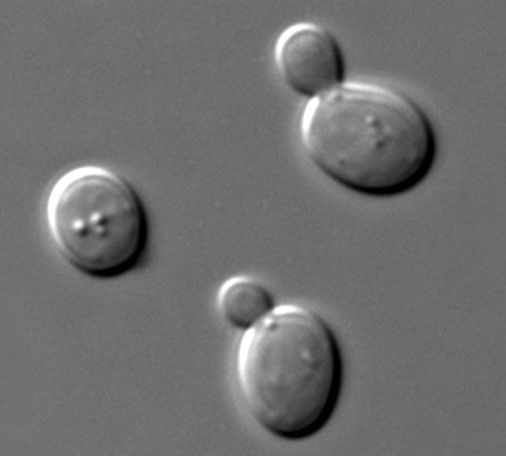
- Yeast is the most widely used facultative anaerobes. Yeast is widely used for carrying out fermentation for alcohol production (like beer and wine) and in bread making.
- B. anthracisis is a facultative anaerobe that produces a powerful exotoxin that can cause respiratory failure, central nervous system distress, anoxia, and even death. This facultative anaerobe has been misused as a biological weapon.
- Mussels are mollusks that are multicellular facultative anaerobic organisms. Change in tides results in exposure of Mussels to aerobic as well as anaerobic conditions. Thus, these organisms have evolved to be facultative organisms that can survive for days without environmental oxygen.


Ecological Importance of Facultative Anaerobes
Since facultative anaerobes have the ability to survive in extreme environmental conditions, i.e., with or without oxygen. These organisms utilize alternative substrates for metabolism like, nitrogen, sulfur, and iron, which have been part of many biogeochemical cycles on the earth that have led to the evolution of life on earth. Thus, these organisms have played a crucial role in preserving as well as continuing the global reserve of the essential elements of life, i.e., carbon, nitrogen, and sulfur, and also the breakdown of the tenacious compounds.
The ability of several autotrophic anaerobes to reduce carbon dioxide increasingly attracts attention as a means for developing a platform for the conversion of waste gases to chemicals, materials, and biofuels. Although, in the past, these organisms were not explored for their industrial utility. More recently, a number of facultative anaerobes are being utilized for wastewater and effluent treatment, valorization of biomass, and soil remediation. These organisms have gained more attention due to their ability to reduce environmental carbon dioxide and are thus being developed as a platform for the conversion of waste gases to chemicals, materials, and biofuels.
In current industrial applications, the majority of the fermentation processes (e.g., ethanol and lactic acid production) facultative anaerobes are being employed to carry out the processes. However, some of the facultative anaerobes can be pathogenic and can cause infections. The most common infectious facultative anaerobe that can be pathogenic include Streptococcus species and the Enterobacteriaceae (fe.g. Escherichia coli).
Read: Types of Fermentation Processes
Try to answer the quiz below to check what you have learned so far about facultative anaerobes.

References
- Hentges DJ. (1996). Anaerobes: General Characteristics. In: Baron S, editor. Medical Microbiology. 4th edition. Galveston (TX): University of Texas Medical Branch at Galveston. https://www.ncbi.nlm.nih.gov/books/NBK7638/
- Joubert, W.A., Britz, T.J. (1987). Characterization of aerobic, facultative anaerobic, and anaerobic bacteria in an acidogenic phase reactor and their metabolite formation. Microb Ecol 13, 159–168. https://doi.org/10.1007/BF02011251
- Simon J. (2013) Electron Transport in Facultative Anaerobes. In: Roberts G.C.K. (eds) Encyclopedia of Biophysics. Springer, Berlin, Heidelberg. https://doi.org/10.1007/978-3-642-16712-6_32
- Duarte, M. S., Salvador, A. F., Cavaleiro, A. J., Stams, A. J. M., Pereira, M. A., & Alves, M. M. (2020). Multiple and flexible roles of facultative anaerobic bacteria in microaerophilic oleate degradation. Environmental Microbiology, 22(9), 3650-3659. https://doi.org/10.1111/1462-2920.15124
©BiologyOnline.com. Content provided and moderated by BiologyOnline Editors.