Diploid
adj., n., [ˈdɪplɔɪd]
Definition: having two sets of each chromosome
Table of Contents
Diploid Definition
Let’s first understand the meaning of the word – diploid. From the words ‘di’, meaning “two”, and ‘ploidy’ which refers to the number of sets of chromosomes in a cell, the term is defined as that which possesses two sets of each chromosome.
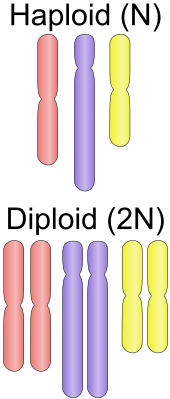
What does diploid mean? In genetics and biology, the term diploid refers to the cell containing two sets of homologous chromosomes wherein each chromosome in a set is obtained from each of the two-parent cells. So you might be wondering, what are homologous chromosomes? Well, a chromosome is basically DNA that is packed with some proteins. And homologous chromosomes are the chromosomes that possess similar or corresponding genes for certain traits. In humans, at each genetic locus, gene variants (alleles) are present and these variants have been inherited from the parent.
The majority of the plants and animals are made up of diploid cells except for their sex cells or the gametes that are haploid. Haploid cells the cells that contain a single set of chromosomes in the nucleus. The fusion of two haploid sex cells results in the formation of a diploid cell called a zygote.
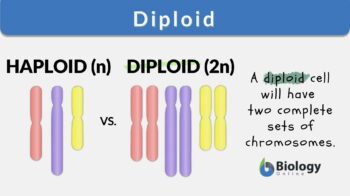
What is a diploid cell? A diploid cell is a cell that contains a diploid chromosome number, meaning the cell has two sets (or two copies) of homologous chromosomes in the nucleus. So, how many chromosomes do diploid cells have? If a haploid cell has ‘n‘ number of chromosomes, then the diploid number would be ‘2n’.
In humans, there are two types of cells: somatic (body) cells and sex cells. The somatic cells are diploid; thus, somatic cells may be considered as a synonym for diploid cells.
Ploidy: Haploid, Diploid and Polyploid
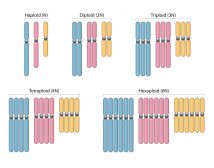
The term ‘ploidy’ refers to the number of chromosomal sets present in a cell, which are represented by ‘n’. Accordingly, cells can be classified on the basis of the number of sets of chromosomes as haploid, diploid, and polyploid (see Table 1). Cells that possess three or more sets of chromosomes are referred to as polyploids. Quite interestingly, ploidy can be as high as 64 sets (tetrahex contaploid); ploidy as high as 10,48,576-ploidy has been reported in silkworms! In humans, polyploid is most often fatal and generally, a polyploid fetus is naturally spontaneously aborted during the early phase of pregnancy. Polyploidy in humans can be due to the absence or appearance of an extra chromosome, which is a condition known as aneuploidy. The most common aneuploidy seen in humans is trisomy wherein there is an appearance of an extra chromosome. Down syndrome (trisomy 21), Patau syndrome (trisomy 13), and Edwards syndrome (trisomy 18) are some of the common trisomy conditions in humans. On the other hand, a missing chromosome results in monosomy. Turner syndrome is a common type of monosomy wherein a female has a missing or damaged X chromosome. Polyploidy is rarely seen in animals (especially higher animals). It is more commonly seen in plants. The potato (Solanum tuberosum), the African clawed frog (Xenopus laevis), and the plains viscacha rat (Tympanoctomys barrerae or red vizcacha rat) are examples of polyploids.
| Table 1: Classification of cells based on the number of chromosomes | |||
|---|---|---|---|
| Ploidy | Chromosomes | Representation | Class |
| Haploid | One set of chromosome | n | Haploid |
| Diploid | Two sets of chromosomes | 2n | Diploid |
| Triploid | Three sets of chromosomes | 3n | Polyploidy |
| Tetraploid | Four sets of chromosomes | 4n | |
| Pentaploid | Five sets of chromosomes | 5n | |
| Hexaploid | Six sets of chromosomes | 6n | |
| Heptaploid | Seven sets of chromosomes | 7n | |
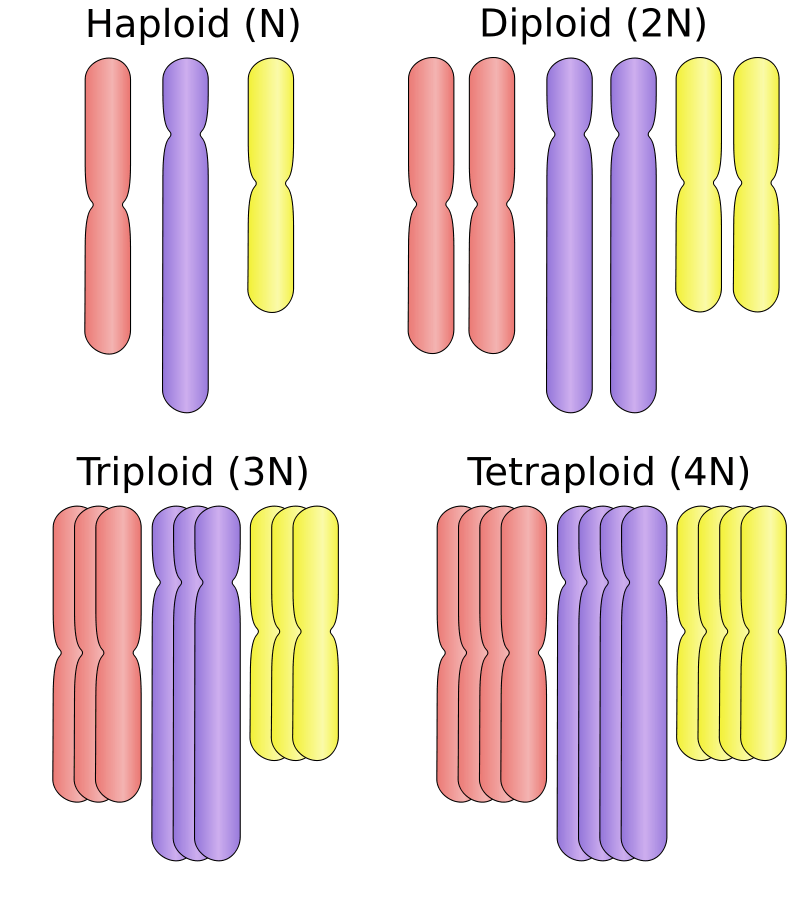
How many chromosomes are in a human diploid cell? And what type of cells are diploid? The chromosomal diploid number in humans is 46 (i.e. 2n=46 chromosomes or 23 pairs of chromosomes). All the body cells like, blood cells, skin cells, muscle cells are diploid. Only sex cells or gametes are not diploid; sex cells are haploid. In that case, one must be curious to know how many chromosomes does a sex cell contains? Human sex cells or the gametes are haploid, and hence, contain n=23 chromosomes. This sentence, thus, clarifies a common query: are human gametes haploid or diploid?
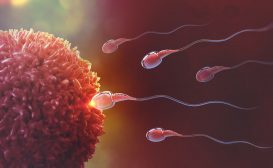
In humans, the sex cells are egg (female sex cell) and sperm cell (male sex cell). Each haploid sex cell contains n=23 chromosomes. At fertilization, the sperm cell unites with the egg cell to form a diploid zygote (2n=46). This is crucial so that the total number of chromosomes inside the cells of the human body remains constant at 46 and the number of chromosomes can stay the same across human generations.
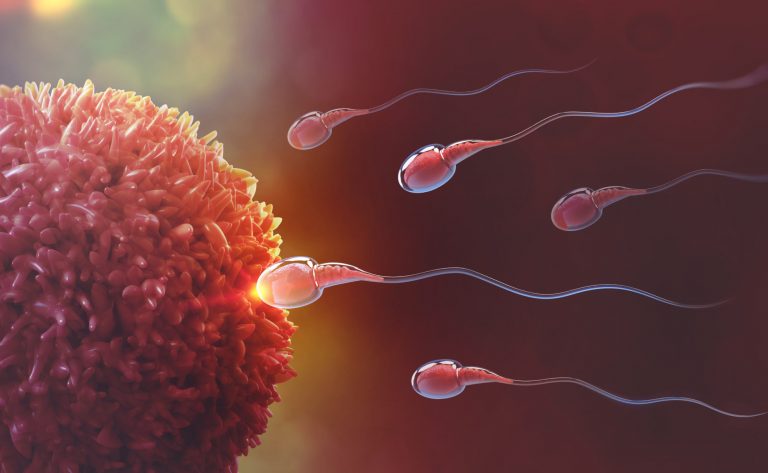
To have half the number of chromosomes, the haploid sex cells are produced by the process of meiosis and to retain the number of chromosomes as it is the haploid sex cells unite during fertilization to form a single cell with now two sets of chromosomes. And from this diploid single cell, more diploid cells will arise via mitotic cell division, forming a multicellular human body.
Meiosis is the process of cell division wherein four daughter cells are formed each containing half the number of chromosomes is present in the parent cell. On the contrary, in mitosis, the product of cell division is the two daughter cells containing the same number of chromosomes. The figure below can help to picture the difference between two types of cell division with respect to the haploid and diploid cell.
Interestingly, organisms like, male bees, wasps, and ants are developed from unfertilized, haploid eggs, and hence, they are haploid organisms.
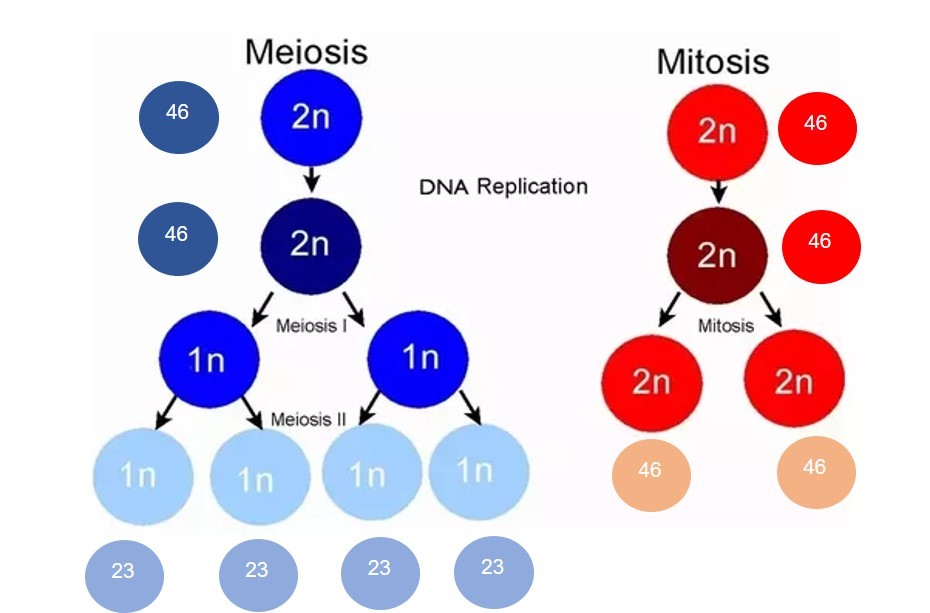
whatisdna.net.
Based on these, we can now differentiate between the haploid cell and a diploid cell; Table 2 states the difference between a haploid and a diploid cell.
| Table 2: Difference between haploid and a diploid cell | |
|---|---|
| Haploid | Diploid |
| A cell that possesses only one set of chromosomes | Cells that possess two sets of chromosomes |
| These cells are produced as a result of meiotic cell division | Mitotic cell division results in the formation of diploid cells |
| In humans, only sex cells or the gametes are haploid cells | In humans, all the cells except sex cells are diploid. These are also referred to as somatic cells |
| Haploid cells are not genetically identical to the parent cell due to the process of cross over during meiosis | Diploid cells are genetically the exact replica of the parent cell, due to mitotic cell division. |
| Examples- Female gamete- ovum/egg; Male gamete- sperm | Examples- muscle cells, skin cells, etc. |
Diploid Examples
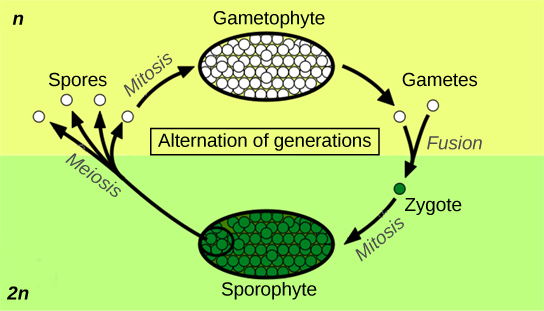
In humans, diploid cells or 2n= 46 (or, 23 pairs of chromosomes), in dogs, 2n=78 (or 39 pair of chromosomes), in the earthworm, 2n=36 (or, 18 pairs of chromosomes) and in E. coli, 2n=1. Animals that are diploid remain diploid throughout their life span; however, many plants can change their ploidy status from haploid to diploid or vice versa. This phenomenon of alteration between two ploidy stages is known as the Alternation of generations. The diploid stage of the plant cycle is known as the sporophytic stage whereas the haploid stage of life is known as the gametophytic stage. In the plant group Pteridophyta, which includes ferns, has predominantly sporophytic stage in their life span.
Interestingly, viruses (like a human foamy virus, human T-lymphotropic virus, and HIV) containing two copies of RNA are also referred to as diploid particles.
Biological Importance of Diploidy
Ploidy level is the determinant of the number of mutations that arise in an individual. Accordingly, a higher number of mutations arise in diploids in comparison to the haploids, as diploids have double the number of mutational targets. However, the utility or the lethality of the mutation is determined by the fitness of the organism and the rate of change in its environmental conditions. In case an organism is not well adapted to its environment or is present in a challenging environment, diploids will have better survival and adaptability rate in comparison to the haploids. However, the evolution process is also critically dependent on the fate of these mutations and their selective effects. In the case of haploids, every mutation, lethal or valuable, would be expressed immediately. Although, mutations become apparent among diploids when they are in heterozygous form. It is important to note that deleterious mutations are more eliminated more efficiently eliminated in haploids than in diploids. Similarly, the probability of retaining a favorable mutation is higher in haploids (~2 s) than in diploids (~2hs). Thus, based on these concepts, diploid organisms are well adapted for changes when evolutionary changes are controlled by mutation, while haploid organisms are well equipped for evolutionary changes when evolutionary changes are controlled by selection.
If you want to learn more about polyploidy, read our tutorial: Polyploidy
Try to answer the quiz below to check what you have learned so far about diploid.

References
- Favier, & Maitre (1965). Les cellules diploïdes humaines [Human diploid cells]. Revue des corps de sante des armees terre, mer, air, 6(2), 227–236.
- Aaronson, S., & Todaro, S. (1969). Human diploid cell transformation by DNA extracted from the tumor virus SV40. Science (New York, N.Y.), 166(3903), 390–391. https://doi.org/10.1126/science.166.3903.390
- Li, Y., & Shuai, L. (2017). A versatile genetic tool: haploid cells. Stem cell research & therapy, 8(1), 197. https://doi.org/10.1186/s13287-017-0657-4.
- Pearson J. (1992). Changing issues of quality control: diploid and non-diploid cell lines. Developments in biological standardization, 76, 13–17.
©BiologyOnline.com. Content provided and moderated by Biology Online Editors.