Conjugation
n., plural: conjugations
[ˌkɑnd͡ʒəˈɡeɪʃən]
Definition: The union or joining together, such as bacterial cells temoporarily joining together (bacterial conjugation)
Table of Contents
Conjugation generally means the joining or coming together (union), such as in certain unicellular organisms (some bacteria, some algae, ciliated protozoans, and certain fungi) and in some multicellular fungi (e.g., zygomycetes and chytrids). It involves the temporary physical connection between two individuals.
For instance, bacterial conjugation is the mechanism of genetic material transfer between two bacteria of the same species when the surfaces of two bacteria are in contact with each other. Bacterial conjugation is the process that accounted for antibiotic resistance and tolerance in bacteria. In multicellular zygomycetes, conjugation is part of the process of sexual reproduction, exchanging genetic material during the temporary union resulting in the formation of a diploid structure called a zygospore.
This module focuses more on bacterial conjugation (microbiology) as an example of conjugation in unicellular organisms. Toward the end, a short note about zygomycete conjugation is presented as an example of the process in multicellular organisms.
Bacterial Conjugation Definition
What is conjugation in biology?
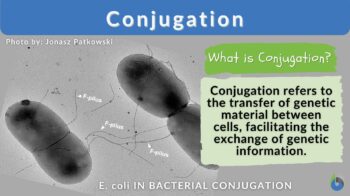
The transfer of genetic material between two bacteria of the same species wherein the two bacterial cells are in surface-to-surface contact or cell-to-cell contact with each other is called conjugation.
Conjugation, transformation, and transduction are types of horizontal genetic material transmission.
- Conjugation is the horizontal transfer of genetic material through a cylindrical tube, which involves direct cell-to-cell contact.
- Transformation acquires floating DNA from the environment.
- Transduction involves the transfer of genetic material through a bacteriophage.
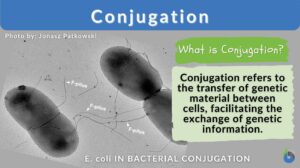
Can conjugation be considered a form of sexual reproduction of bacteria? Bacterial conjugation is considered to be equivalent to the sexual mode of reproduction in sexual organisms. This is because bacterial conjugation involves the transfer of genetic material between bacterial cells which is somewhat similar to the exchange of genetic material during mating. However, conjugation differs from reproduction because conjugation pertains only to the transfer of genetic material, no new cell is created during the process. Also, bacterial conjugation involves the horizontal transmission of genetic material between two bacteria (Figure 1). E.coli is an example of bacteria that exhibits conjugation gene transfer.
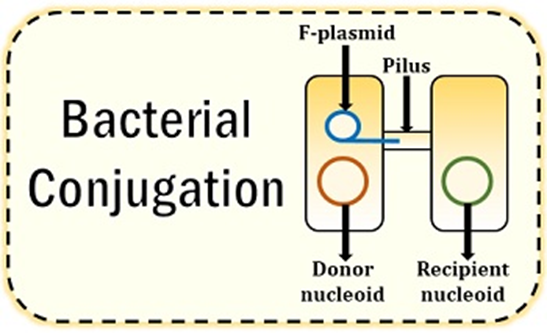
In bacterial conjugation, transfer of F-factor plasmid (or fertility factor) occurs. Also, bacterial DNA conjugation is the primary cause of the spread of antibiotic resistance among bacterial colonies. Usually, bacterial populations acquire the ability to produce new metabolites and adaptation/tolerance to xenobiotics by bacterial conjugation.
F-factor is a type of plasmid. Interestingly, F-factor was the first plasmid that was discovered. F-factor is a duplex DNA of 100kb. F-factor is also referred to as the sex factor/conjugation plasmid, as it encodes for bacterial conjugation. F-factor has all the necessary genes that encode for pilli formation and activation of synthesis of DNA at the site of plasmid’s OriT or plasmid’s origin transfer. OriT is the point or segment that marks the beginning of the transfer by conjugation. Also, F-plasmid is capable of synthesizing cytoplasm independently from bacterial chromosomes.
In bacterial conjugation, one of the bacteria acts as a donor while the other is the recipient. Accordingly, the bacteria that donate or give away the F-plasmid are referred to as Donor bacteria and are represented as F+. While the bacteria that accept the F factor are referred to as Recipient bacteria and are represented as F-. The F-factor encodes for the pilus formation. Pilus is the tube-like protrusion on the bacterial surface through which two bacteria join and transfer the genetic material.
Watch this vid about bacterial conjugation:
Biology definition:
Conjugation is the act or state of joining together or union just as the temporary joining together of two individual organisms to transfer genetic material from the donor cell to the recipient cell. In bacteria, the transfer of genetic material is done via the plasmid (either as solitary or as part of a chromosome). This is also observed in single-celled eukaryotes, such as certain protozoans, algae, and fungi. Another form of conjugation is observed in some multicellular fungi, such as zygomycetes and chytrids.
Etymology: from Latin “coniugātiō”, meaning “combining”, “connecting”, from “coniugō”, meaning “join”, “unite together”, from con- (“‘with’”) + iugō (“‘join, bind, connect’”).
Bacterial Conjugation Steps
The foremost step is the coming together of two bacterial cells wherein the two cells come in contact with each other. Once the contact between two bacterial cells is established, the F-plasmid in the donor cell generates double-stranded circular DNA.
Post-synthesis of double-stranded DNA, its transfer occurs through the following process (Figure 2):
Step 1:
The donor bacterial cell develops pilus. Pilus is a cylindrical tube-like structure through which the transfer of genetic material takes place. The pilus produced from the donor cell (F+) then comes in contact with the recipient bacterial cell (F-).
Step 2:
Through the pilus, the two bacterial cells establish a direct connection between them.
Step 3:
Since the F-plasmid is a highly coiled double helical structure, prior to its transfer through the pilus, it needs to be uncoiled. Hence, an enzyme, relaxase or relaxosome, acts on the plasmid DNA to splice or nick off one of the two strands of plasmid DNA. This results in the formation of a T-strand, which is eventually transferred to the recipient bacterial cell.
Step 4:
Once the T-strand is transferred, both bacterial cells have a single-stranded DNA. This single-stranded DNA then undergoes replication to synthesize double-stranded DNA in each of the bacterial cells. Thus, both the donor cell as well as recipient cell now possess an F-plasmid that has all the required genes and proteins for the formation of pilus.
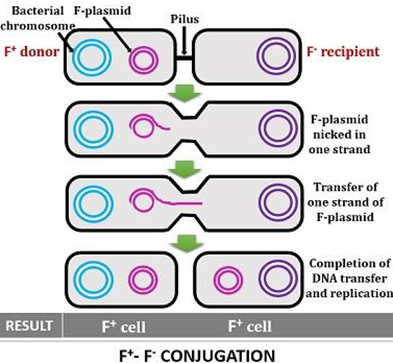
DNA Transfer
One may wonder, how bacterial cells do not undergo bacterial conjugation with the bacterial cells already having F-plasmid. How does a bacterial cell come to know that the other bacterial cell in the vicinity already possesses F-plasmid?
Well, donor bacterial cells possess all the necessary information that allows the donor cell to identify the recipient cell, without a F-plasmid.
An F-plasmid contains the following segments:
- Origin of transfer (OriT) – Initiation segment that initiates the DNA synthesis. At OriT, enzyme relaxase act to splice the plasmid DNA into two separate strands to form the T-strand.
- Origin of Vegetative replication (OriV) – The segment that initiates the DNA replication in the recipient cell.
- Two main loci (tra and trb) – tra is the segment that contains genes encoding for proteins (pilin genes) involved in pilus formation and subsequent DNA transfer; trb segment contains genes encoding for proteins that help to create channels for the transfer of DNA.
It has been seen that in some cases, during bacterial conjugation, along with the transfer of F-plasmid from the donor bacterial cell to the recipient cell, there can be a transfer of chromosomal DNA. In such a case, the bacterial conjugation occurs for a longer duration wherein a significant amount of chromosomal DNA transfer occurs along with F-plasmid DNA.
Application Of Bacterial Conjugation
Bacterial conjugation genetics is the basis of bio-engineering. Using this technique, a significantly large amount of DNA/genetic material can be transferred or inoculated into the bacterial cell without harming the host bacterial cell. The transfer of genetic material through conjugation not only occurs in bacteria, but it is also possible in yeast cells, mammalian cells, and plant cells, it thus opens frontiers for varied possibilities in genetic engineering.
NOTE IT!
An Interesting Case of Inter-kingdom Conjugation
Agrobacterium tumefaciens, a Gram-negative bacteria undergoes conjugation and transfers the genetic material in plant tissue to induce tumor formation. The Ti (tumor-inducing) plasmid is transferred from the Agrobacterium tumefaciens into the plant cells as a result the T plasmid gets incorporated into the plant cell genome which causes tumor formation or crown galls in the plants. Similar to the Agrobacterium tumefaciens, A. rhizogenes transfers Ri plasmid in plant cells resulting in tumor cell or root nodule formation that fixes nitrogen for the bacteria. Agrobacterium tumefaciens is widely used as a tool for generating transgenic plants whereas A. rhizogenes helps in nitrogen fixation in legumes.
Conjugation as a Sexual Process in Zygomycetes
Zygomycetes are multicellular fungi that belong to the phylum Zygomycota. The black bread mold Rhizopus stolonifer is one of them. The life cycle of zygomycetes is complex in a way that it has two routes: one that is sexual and the other, asexual. In their sexual life cycle, conjugation is a part of the initial stage, which leads to the formation of the structure called zygosporangium (a structure that forms zygospores, diploid reproductive spores).
In the diagram below, the two individual fungal hyphae of opposite mating types (referred to as type “+” and type “-“) are shown to come into contact and undergo conjugation via special structures called gametangia. The cytoplasmic fusion (plasmogamy) and the subsequent nuclear fusion (karyogamy) lead to the formation of a zygote with multiple fused nuclei enveloped in a thick protective coat (which at this point are called zygospores).
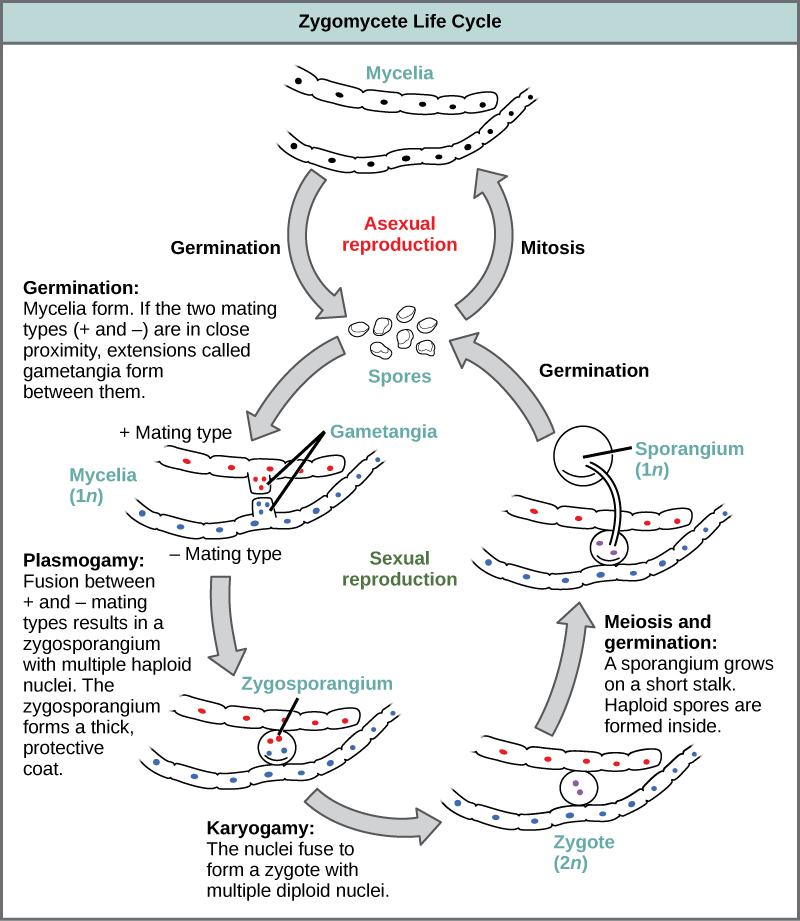
The zygospore is resistant to harsh environmental conditions. Thus, the sexual life cycle of zygomycetes is the route that zygomycetes tread when conditions are unfavorable. They remain dormant until conditions become favorable again. The zygospore undergoes meiosis to generate haploid spores that will germinate and grow into a new organism.
Take note that bacterial conjugation is different from zygomycete conjugation.
- In bacteria, there are donor and recipient cells ascribed as (+) and (-). No gametes and no zygote formation are involved. Thus, conjugation in this sense is not a sexual reproduction.
- In zygomycetes, plus (+) and minus (-) signs are used as shorthand notations to distinguish between hyphae of opposite mating types only. Gametangia are reproductive hyphal cells formed to facilitate conjugation. Zygote is formed. Thus, conjugation in this sense is a sexual form of reproduction.
Take the Conjugation – Biology Quiz!

References
- Ghigo J. M. (2001). Natural conjugative plasmids induce bacterial biofilm development. Nature, 412(6845), 442–445. https://doi.org/10.1038/35086581
- Llosa, M., Gomis-Rüth, F. X., Coll, M., & de la Cruz Fd, F. (2002). Bacterial conjugation: a two-step mechanism for DNA transport. Molecular microbiology, 45(1), 1–8. https://doi.org/10.1046/j.1365-2958.2002.03014.x
- Neil, K., Allard, N., & Rodrigue, S. (2021). Molecular Mechanisms Influencing Bacterial Conjugation in the Intestinal Microbiota. Frontiers in microbiology, 12, 673260. https://doi.org/10.3389/fmicb.2021.673260
- Virolle, C., Goldlust, K., Djermoun, S., Bigot, S., & Lesterlin, C. (2020). Plasmid Transfer by Conjugation in Gram-Negative Bacteria: From the Cellular to the Community Level. Genes, 11(11), 1239. https://doi.org/10.3390/genes11111239
- 9.8: Zygomycota- The Conjugated Fungi. (2021, January 13). Biology LibreTexts. https://bio.libretexts.org/Courses/Lumen_Learning/Biology_for_Majors_II_(Lumen)/09%3A_Module_6-_Fungi/9.08%3A_Zygomycota-_The_Conjugated_Fungi
©BiologyOnline.com. Content provided and moderated by Biology Online Editors.