Autotroph
n., plural: autotrophs
[ˈɔɾəˌtɹoʊf/]
Definition: an organism capable of making its own food by photosynthesis or by chemosynthesis
Table of Contents
Autotroph Definition
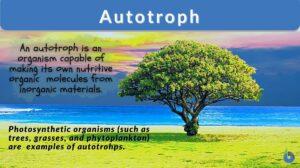
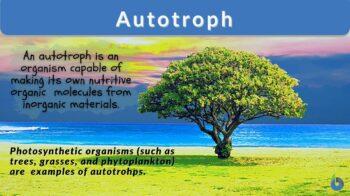
What is an autotroph? In biology and ecology, an autotroph is an organism capable of making nutritive organic molecules from inorganic materials. It could be through photosynthesis (involving light energy) or chemosynthesis (involving chemical energy).
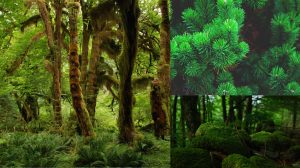
Organisms that synthesize food molecules through photosynthesis are referred to as photoautotrophs whereas those that do so through chemosynthesis are called chemoautotrophs. Another name for an autotroph is autophyte. It can also be called a producer for its capacity to produce its own food. Examples are shown in the autotroph picture below.
Etymology: from Greek autos, meaning “self” and trophe, meaning “nutrition”
Synonyms: autophyte; autotrophic organism; primary producer.
Compare: heterotroph.
Types of Autotrophs
Autotrophs are capable of manufacturing their own food by photosynthesis or by chemosynthesis. Thus, they may be classified into two major groups:
Photoautotrophs
Photoautotrophs produce complex organic compounds, such as carbohydrates, fats, and proteins, from inorganic substances and light energy via photosynthesis. Here is a simplified equation to define the process: 6CO2+12H2O+energy = C6H12O6+6O2+6H2O. Photoautotrophs have specialized light-capturing pigments (chlorophylls). These pigments are found inside the cell, particularly in the green plastid organelles called chloroplasts. The green color is due to the presence of chlorophyll pigments.
Aside from chlorophyll, other pigments are also present in a photoautotrophic cell. Non-chlorophyll pigments inside the chloroplasts are referred to as accessory pigments. Examples are carotenoids and phycobilins. They serve as accessory pigments, absorbing light as well. They relay it to the chlorophyll-rich light-harvesting antenna complexes.
Inorganic sources include carbon dioxide, inorganic salts, and water. Light comes from natural sources, such as sunlight. Light energy is essential for the light reactions of photosynthesis, which cannot proceed without it. By contrast, dark reactions can proceed even without light.
Nevertheless, as science progressed over the years, alternative light sources, such as LEDs, were contrived and have proven useful in inciting photosynthesis even in the absence of light, such as at nighttime or indoors. Artificial lighting also confers the advantage of regulating light in terms of absorption spectra and quantity that will likely produce the desired outcome.
As light has been an important limiting factor in photosynthesis, progressive scientific research in agriculture and horticulture helped substantially in improving yield and crop resistance.
Chemoautotrophs
Chemoautotrophs are those that make organic compounds as food by chemosynthesis. They use chemical energy to produce carbohydrates instead of light energy as photoautotrophs do. They utilize inorganic compounds such as hydrogen sulfide, sulfur, ammonium, and ferrous iron as reducing agents.
Autotroph Examples
Examples of photoautotrophs are land plants (e.g. dicots, grass, gymnosperms, bryophytes, ferns, etc.), lichen, photosynthetic algae (e.g. chlorophytes, charophytes, dinoflagellates, diatoms, etc.), photosynthetic bacteria (e.g. cyanobacteria), and other plant-like plankton groups. They have a distinctively green color.
As mentioned earlier, the green is due to the presence of light-absorbing green pigments, chlorophyll, in high amounts. Another main feature is the presence of starch as stored sugar. They also produce and release oxygen as a by-product of photosynthesis. Major oxygen producers are the phytoplankton in marine habitats.
Chemoautotrophs include methanogens, halophiles, nitrifiers, thermoacidophiles, and sulfur oxidizers. These autotrophic bacteria are extremophiles. They are found thriving in hostile habitats and where light cannot easily penetrate through.
The Role of Autotrophs in an Ecosystem
Why are photosynthetic autotrophs important to the ecosystem? For one, autotrophs are the primary producers in a food chain, and in the ecological pyramid, they are the ones occupying the base. They are self-feeding organisms, which means they do not rely on other organisms for food.
They have their own biological machinery that creates food for them. As opposed to autotrophs, animals cannot make their own food and therefore they depend upon the primary producers, directly or indirectly. Referred to as heterotrophs, they rely on the autotrophs directly, i.e. by eating them, or indirectly, i.e. by eating organisms that feed on autotrophs. The starch stored by photoautotrophs is an energy-rich carbohydrate and therefore it is a vital source of energy for various metabolic activities.
Autotrophs are also important nutrient “cyclers” of the ecosystem. They autotrophically convert compounds into simpler molecules or to another form that are either released into the environment or stored in the organism. For instance, in the carbon cycle, their role is to utilize carbon from carbon dioxide molecules when creating carbon-containing sugar molecules (e.g. glucose, C6H12O6).
They are also a source of oxygen. They release oxygen to the environment through transpiration. Aerobic organisms, in turn, use oxygen, particularly for aerobic respiration. Scientists believe that with the emergence of oxygen by the photosynthetic activity of autotrophs the Earth eventually became more conducive to life.
Oxygen is important in living things, especially animals. They take in oxygen for use in redox reactions during ATP synthesis. ATP is the cell’s major energy currency. Without it, many metabolic activities would not proceed as they should.
Watch this vid! Know the difference between autotrophs and heterotrophs.
Take the Biology Quiz – Autotroph!

Further Reading
See also
- Trophic level
- Heterotroph
- Ecological pyramid
- Photosynthesis
- Chemosynthesis
References
- Cooper, G. M. (2012). Photosynthesis. Nih.Gov; Sinauer Associates. https://www.ncbi.nlm.nih.gov/books/NBK9861/
- What is Photosynthesis. (2017, April 12). Smithsonian Science Education Center. https://ssec.si.edu/stemvisions-blog/what-photosynthesis
- LED Lighting Improves Sustainability for Specialty-Crop Producers. (2017). Usda.Gov. https://www.usda.gov/media/blog/2013/09/24/led-lighting-improves-sustainability-specialty-crop-producers
©BiologyOnline. Content provided and moderated by BiologyOnline Editors.