Adaptation
n., ˌædæpˈteɪʃən
The process or the state of adjusting or changing to become more suited to an environment; the trait as a result of the process
Table of Contents
Adaptation Definition
In biology and ecology, adaptation refers to the process of adjusting behavior, physiology, or structure to become more suited to an environment. It may also be defined as the state reached by the biological population undergoing adjustments or changes. It may also pertain to the trait that made the species a better fit for the environment. The trait is referred to as the adaptive trait.
In neurology, adaptation refers to the decline in the frequency of firing of a neuron. In ophthalmology, it is the ability of the eye to adjust to various light intensities by regulating the pupil of the quantity of light entering the eye through the pupil.
However, this article focuses on the biological or ecological aspect of adaptation. Let’s learn more about it below.
What is Not an Adaptation
The term adaptation came from the Latin “adaptō”, meaning “I fit” or “I adjust to”. It is a common word in ecology and evolutionary biology. The organism tends to undergo changes to become more suited or fit to its environment.
So the next question is: “What is not an adaptation?”
Adaptation vs. acclimatization
Adaptation is not acclimatization. Both terms are about changes. However, acclimatization is the physiological adjustment to the new conditions but it does not entail increasing species diversity as adaptation does. For a trait to be considered as an adaptation, it has to be heritable, functional and increases fitness. (Ref. 1)
According to Charles Darwin’s theory of evolution by natural selection, the organisms adapt to their environment so that they could persist and pass their genes on to the next generation. In the ecosystem, several species co-adapt, and in so doing they also co-evolve. Take for instance the symbionts in a lichen association. The algal and fungal components tend to co-evolve together as the absence of one implicates death. The dependence on each other’s existence means they have to adapt together, and survive together.
Vestigial structures
Vestigial structures are not considered adaptive traits. It is because their presence apparently does not confer any function or benefit to the organism, which, contrastingly, an adaptive trait does. Thus, a structure that has become vestigial and non-functional may not be regarded as an adaptive trait. Examples of vestigial structures, and therefore aren’t adaptive traits are:
- The pelvic bone of the snake
- Human vomeronasal organ
- Male nipples
- Whale pelvis
Types of Adaptations
Adaptations are essential to the species’ survival. The adaptive traits that the species will acquire through time may be structural (i.e. physical adaptive traits), behavioral (e.g. vocalizations, courtship rituals, nesting, and mating), or physiological (e.g. developing resistance to diseases or to toxic chemicals). (Ref. 1, 2)
Examples of Biological Adaptations
One of the major characteristics of a living thing is its ability to respond to stimuli and adapt to environmental changes. It has various senses that enable it to detect changes in its surroundings. And it doesn’t stop there. It may also be able to adapt by acquiring traits that will make it more suitable for living in an ever-changing environment. You may want to read this article to know the other characteristics of living things.
-
Owls
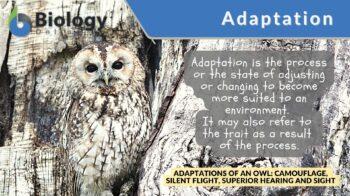
These nocturnal birds are known for their ability to sneak up and catch unsuspecting prey due to their ability to camouflage (blend into their surroundings) and fly almost silently owing to the soft and highly adapted feathers that enable a silent flight. They also have superior sight, thanks to their eyes which are huge and relatively larger than their skulls. Their eyes are described as “nocturnal eyes”, being fixed and tubular. Even if they cannot move their eyes in any direction, they are capable of moving and rotating their heads for ~360-degree vision. Not only do they have superior sight but they can also hear well and locate their prey even at night. And let’s not forget about their talons and beaks! Owls’ talons (claws) are sharp and curved. They can crush the skull and knead the body of their prey. Their beaks are also curved. They may be short but they are usually hooked at the tip for gripping and tearing their prey.
-
Plants
Plants’ inability to move from one place to another as extensively as most animals do makes them one of the most highly adapted creatures on Earth. They may not be able to escape stormy weather or the scorching heat of the sun as some animals would, they have acquired adaptations that enable them to survive harsh environmental conditions. For instance, xerophytes (e.g., cactus plants) are able to thrive in the deserts because they can reduce the transpiration rate and promote water retention. Notice the “spines” on their plant body? These spines are actually their modified leaves. The spine leaves prevent excessive water loss from transpiration. Their waxy succulent stem is green, indicating that it is modified into serving as a major photosynthetic organ apart from serving as efficient water storage.
-
Humans
Humans are arguably considered the most adaptive species. (Ref.3) That is because of humans’ social brains. Thus, despite the constant climate change, humans have this flexibility that enables them to survive to this day by sharing information and passing on knowledge to come up with solutions that will help them adjust to new situations. But apart from that, humans do have some astounding anatomical and physiological adaptive traits, such as the ability to walk upright on two feet (bipedalism), regulate body temperature by sweating, use our hands to make tools and throw objects with an aim or targeted precision, hardy teeth, and sophisticated communication.
Watch this video about adaptation in animals.
This video is about adaptation in plants
Take the Adaptation Biology Quiz!

Further Reading
- The uniqueness of New Zealand Plants – Science Learning Hub. (Get to know the diverse plants in New Zealand and their adaptations).
- Adaptation Tutorial
References
- Defining adaptation. (2020). Berkeley.Edu. https://evolution.berkeley.edu/evolibrary/article/0_0_0/misconcep_06
- Adaptation. (2020). Berkeley.Edu. https://evolution.berkeley.edu/evolibrary/article/evo_31
- Massey,ClimateWire, N. (2013, September 25). Humans May Be the Most Adaptive Species. Scientific American. https://www.scientificamerican.com/article/humans-may-be-most-adaptive-species/
©BiologyOnline. Content provided and moderated by BiologyOnline Editors.